Garage Door Repair in North Miami Beach
Garage door repair in North Miami Beach often starts with a door that has worked for years and then suddenly won't: a spring that lets go, an opener that strains, a door that refuses to reverse. Momentum picks up the phone for those problems at any hour, every day.
(954) 636-6320
North Miami Beach garage door repair, part by part
Decades-old houses and the doors inside them
Much of North Miami Beach's housing went up after State Road 826 was finished in 1951, according to the City of North Miami Beach. Today the city covers about 5.2 square miles, with starter homes, waterfront properties, condominiums and apartments.
In a house that has stood for decades, the garage door hardware may have been swapped out piece by piece over the years, or not at all. A standard torsion spring is often rated for around 10,000 open-and-close cycles, so a door used several times a day can wear through its spring in well under ten years.
Older openers deserve a closer look as well. Openers sold in the U.S. since the early 1990s have had to include entrapment protection, usually a pair of photo-eye sensors, and that reversing feature only protects anyone if it still works. Our step-by-step guide shows how to test the auto-reverse safely at home.
ZIP codes used for North Miami Beach addresses: 33160, 33162, 33169, 33179, 33181
Help after dark and on weekends
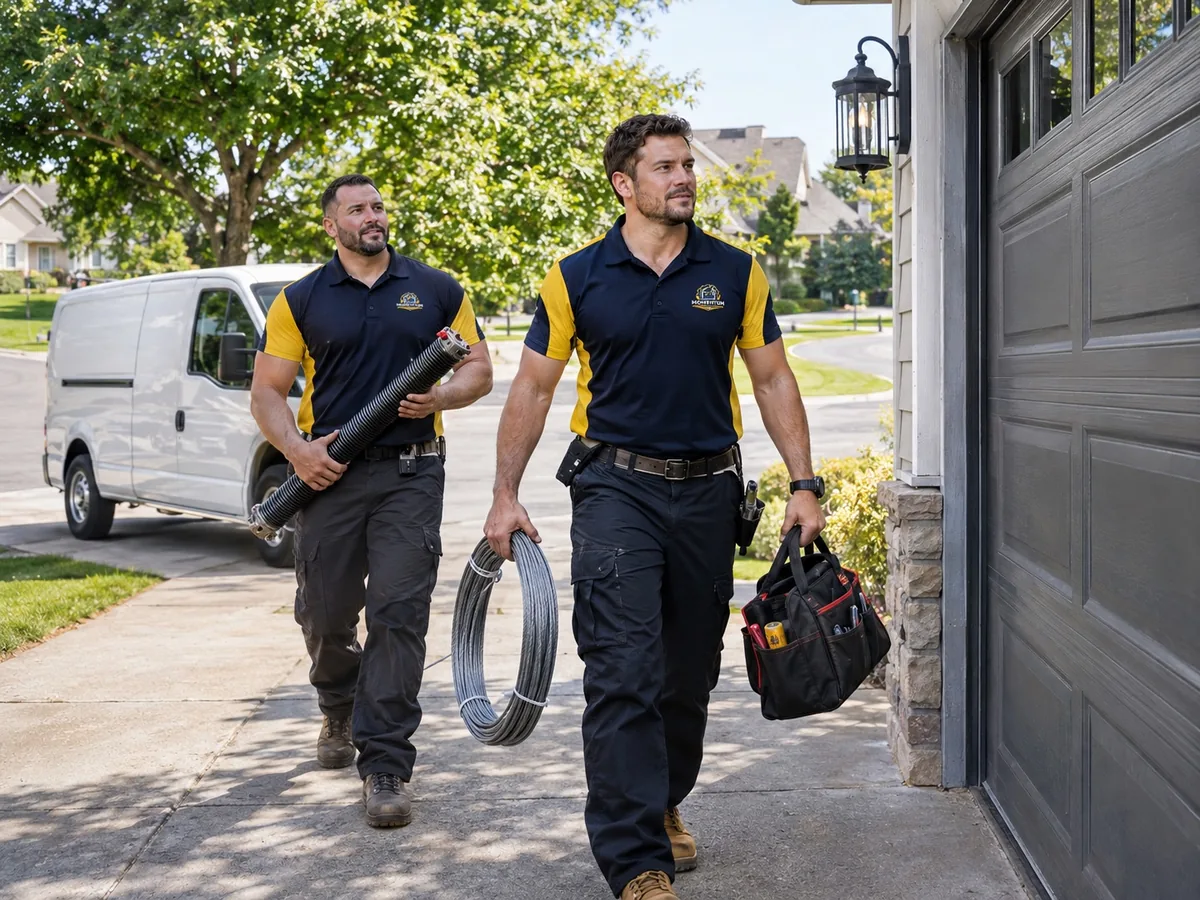
North Miami Beach sits within the area Momentum covers, which runs north from Bal Harbour into Broward County. There is no wrong time to call, because the line stays open day and night.
- Stop pressing the remote if the opener hums but the door stays put.
- From a safe distance, look up at the springs and note any visible gap in a coil.
- If you know roughly how old the opener is, mention it when you call.
Garage door repair in North Miami Beach depends on the kind of home
North Miami Beach is not a city of matching subdivisions. The Census Bureau's American Community Survey (2020 to 2024 estimates) counts about 17,500 housing units in the city, and they split into very different kinds of buildings. Only some of them come with a garage door that belongs to the person living there.
That matters before anyone picks up a tool. In a detached house, the door, the springs and the opener are the owner's to fix. In a big condominium building, the parking garage door is usually shared property, and the association or building manager makes the call.
| Type of building | Units | Share |
|---|---|---|
| Single-family, detached | 6,749 | about 38% |
| Single-family, attached (townhome style) | 791 | about 5% |
| 2 to 4 units | 812 | about 5% |
| 5 to 19 units | 1,396 | about 8% |
| 20 to 49 units | 2,085 | about 12% |
| 50 or more units | 5,171 | about 30% |
| Mobile home | 529 | about 3% |
Two numbers stand out. Close to a third of all homes sit in buildings with 50 or more units, and a little more than half of occupied homes are owner-occupied (about 52%, against about 48% rented). So a renter in a house with a stuck door often has a landlord to call first, and a condo owner has an association. The detached houses are where a homeowner usually decides on a garage door repair alone.
Four out of five homes went up before 1980
The same Census survey asks when each building was put up. In North Miami Beach the 1950s are the biggest decade by far, which fits the city's own history: its growth took off after State Road 826, North Miami Beach Boulevard, was finished in 1951. Roughly 81% of today's housing units are in buildings from before 1980.
Parts from different decades
A house from the 1950s has likely had its garage door, opener or springs changed at least once. It's common to find a newer opener on an older door, or one new spring beside an old one. Mismatched parts are a frequent reason a door feels heavier on one side or drifts when it's let go halfway up.
Extension springs along the tracks
Many older single-car setups lift the door with extension springs that stretch along each horizontal track, not one torsion spring over the opening. Each of those springs should have a safety cable running through it, so a snapped spring can't whip across the garage. If you can't see a cable inside each spring, mention it when you call. See broken spring repair.
Hinges, struts and tired sections
Decades of opening and closing loosen hinge screws and crack the steel around them, especially on the top section where the opener arm pulls. A section that bows or a hinge that has torn loose is a panel and section question, not something to fix with extra screws.
| Built | Units | Share |
|---|---|---|
| Before 1950 | 629 | about 4% |
| 1950 to 1959 | 5,394 | about 31% |
| 1960 to 1969 | 3,882 | about 22% |
| 1970 to 1979 | 4,226 | about 24% |
| 1980 to 1999 | 1,385 | about 8% |
| 2000 or later | 2,017 | about 12% |
In an older house, the opener's age is worth checking too, since the safety features required on openers have changed over the years.
Tidal water, canals and the lower half of the door
North Miami Beach began on the water. The city's history page says Captain William Fulford explored Big Snake Creek in 1881, the stream later renamed the Oleta River, and that early land buyers were brought up from Miami Beach by tour boat on the Intracoastal Waterway. The Snake Creek Canal still runs through the city. By the Census Bureau's measure, about half a square mile of the city's area is water.
Water and salt work on a garage door from the bottom up. Salt residue holds moisture against steel, so rust tends to start low on the door and on the hardware closest to the floor. These are the spots worth a look a few times a year:
- Bottom brackets. The lift cable hooks onto these at each lower corner, and they hold the full tension of the springs. Heavy rust here is a job for a technician, never for a wrench. See cable repair.
- The lift cables themselves. Look for frayed strands near the bottom, where the cable meets the bracket.
- The lowest rollers and the bottom of the vertical tracks. Rust and grit make rollers drag or stop turning. See roller replacement.
- The bottom seal and its retainer. A torn seal lets water and sand in. Our guide to replacing the bottom seal walks through it.
- The lower edge of the bottom section. Paint bubbles or rust along the edge usually mean water has been sitting there.
The city says some portions of North Miami Beach are mapped by FEMA as Special Flood Hazard Areas, and that different parts of the city carry different levels of flood risk. Its Building Department keeps elevation certificates for buildings built or substantially improved after 1997, and the floodplain manager will visit a property on request to look at a flooding problem. For routine care in salty air, see protecting a garage door from salt air.
What the Building Department asks for on door, window and shutter permits
Most garage door repairs keep the door you already have. Changing a door is different, and North Miami Beach publishes a checklist for permits on doors, windows and shutters. It's useful to know what it asks for, even if you only need a repair, because it explains why replacement parts have to match the door's approval. In summary, the checklist asks for:
- A permit application, signed and notarized.
- For an owner-builder, an owner affidavit and a copy of the owner's driver's license, with the owner present when the permit is submitted.
- A floor plan showing every door, window or shutter being changed, with sizes, plus the roof mean height and the building's length and width.
- A Notice of Acceptance, also called a product approval, from Miami-Dade County or the State. If a door has no missile impact rating, shutters are needed, and their approval has to be submitted too.
- For contractors: a state license or a certificate of competency, a local business tax receipt, liability and workers' compensation insurance, and the qualifier's licenses registered with the city.
- For condominiums: a Condominium Approval Form, and the installation has to be done by a licensed professional only.
The city's procedures sheet adds that wind loads are worked out under Chapter 16 of the Florida Building Code, and that the wind pressures and the approval number are shown for each door on the drawings. For a single-story, single-family house, it says wind load calculations aren't required when the door's design rating is above plus or minus 55 pounds per square foot.
What does a garage door approval actually cover? One current Miami-Dade Notice of Acceptance for a steel sectional garage door, picked as an example, says the door was designed to meet the Florida Building Code including the High Velocity Hurricane Zone. It lists tests for static air pressure, large missile impact, cyclic wind pressure and forced entry, plus a salt spray test on the steel panels. A door is approved as a whole system, so struts, sections and other parts that hold it together are not interchangeable with anything that happens to fit.
Questions about a specific job go to the Building Department at (305) 948-2965.
Before a storm: what Miami-Dade County tells homeowners
North Miami Beach is in Miami-Dade County, and the county's hurricane guidance includes garage doors by name. Its advice is to reinforce garage doors and their tracks, or replace them with a hurricane-tested door, and to secure windows and doors with county-approved shutters or 5/8-inch plywood. It also warns that a shuttered house is harder to get out of, so everyone should know the exits first.
For the garage door itself, a short pre-season routine covers most of it:
- Close the door all the way and look at the bottom edge. A gap at one corner can mean a cable or spring problem that wind will find.
- Look along both tracks for bent spots or loose brackets.
- Find the red emergency release cord and make sure everyone at home knows what it does. Pull it only with the door closed.
- If the door has storm braces, find them before June, not the day a warning is issued.
- Write down the opener brand and model. It saves time if you need help after the power comes back.
The city keeps photos of what the 1926 hurricane did to Fulford, then the city's name, including destroyed homes. Storms here are not a new problem. Our full checklist is in getting a garage door ready for a hurricane, and opening a garage door without power covers the release cord step by step.
House, townhome or condo: what to do when the door stops
Start with who is responsible. In a detached house you own, the decision is yours. In a townhome, read your association documents, because some make the owner responsible for the door and others don't. In a condo parking garage, call the building manager, and note that the city's door, window and shutter checklist says installations in condominiums must be done by a licensed professional. Our article on HOA garage door responsibility goes into the usual splits.
Then match what you see to the right kind of repair:
| What you notice | What it often means | Where to start |
|---|---|---|
| A loud bang from the garage, and now the door is very heavy | A spring has broken | Spring repair |
| The door hangs crooked or one side is slack | A cable has slipped or snapped | Cable repair |
| Rollers have popped out and the door is jammed | The door has come off its track | Off-track repair |
| The opener runs but the door won't move, or it hums | A worn opener part, or the door is too heavy for it | Opener repair |
| The door starts down, then reverses, and the lights blink | The safety sensors are blocked or out of line | Sensor repair |
| A section is bent, cracked or pulling away at a hinge | Damaged section or hardware | Panel replacement |
| The door is stuck open at night or before a storm | Any of the above, with no time to wait | Emergency repair |
Whichever row fits, don't keep pressing the remote on a door that won't move, and don't touch springs, cables or bottom brackets. Momentum answers (954) 636-6320 at any hour.