Garage Door Opener Repair
The motor hums but the door stays put. The door starts down, then bounces back up. The remote quit answering last week. Momentum handles garage door opener repair for homes in Bal Harbour, North Miami and the surrounding areas, and takes calls 24 hours a day, 7 days a week.
(954) 636-6320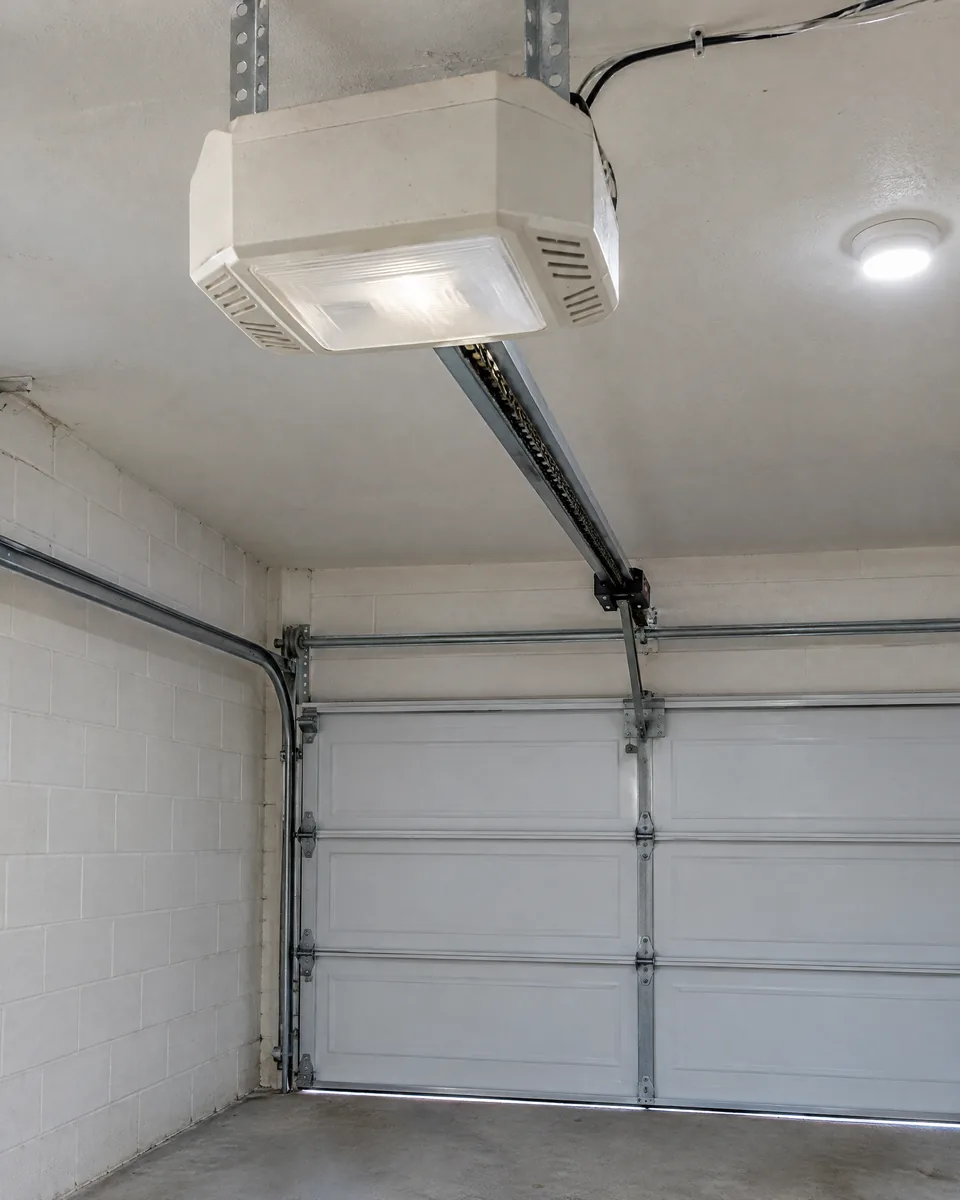
Is the opener worth repairing?
Most opener faults trace back to one part, such as a sensor, a gear, a circuit board or a remote. The age of the unit and the state of the door decide whether fixing that one part is worth it. These are general signs, not a verdict on your opener.
A repair usually makes sense if
- The opener is fairly young and ran without trouble until now.
- One clear symptom points to one part, like a stripped gear or a remote that needs pairing again.
- The door itself is balanced and moves freely by hand.
- The unit already has what you want, such as a battery backup or phone control.
- Parts for that model are still easy to get.
Replacing it may be the better call if
- The opener is old enough that parts are hard to find.
- It has failed several times in a short stretch.
- It predates the photo-eye safety sensors found on newer openers.
- You want a quieter drive or a battery backup. Installing a new opener covers those choices.
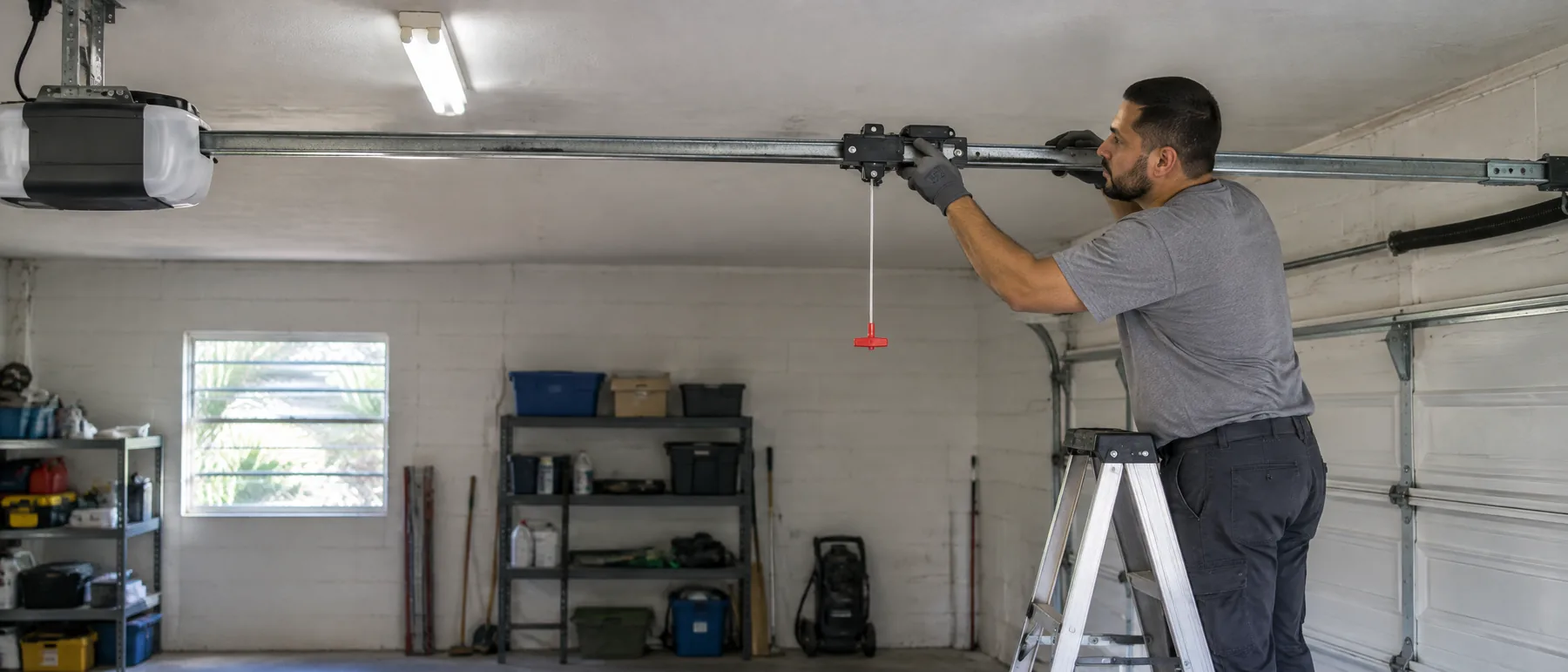
Five safe checks when the opener won't work
Some opener problems turn out to be simple. These checks need no tools and keep your hands away from the springs and cables.
- Make sure the opener is plugged in and the outlet has power. A tripped GFCI outlet or breaker can cut it off without anyone noticing.
- Look at the wall control. Many have a lock or vacation button that blocks the remotes while the wall button still works.
- Put a fresh battery in the remote. If the wall button works and the remote doesn't, the battery or the pairing is the usual suspect.
- Check the small lights on the two safety sensors near the floor. A dark or flickering light often explains a door that won't close.
- If the door is closed and nothing looks broken, pull the emergency release cord and lift the door a little by hand. A door that barely moves points to the springs, not the opener. Lower it gently and leave it there.
If none of this explains it, stop and call. Opening the motor housing exposes wiring that stays live while the unit is plugged in.
What the opener is telling you
Each symptom has a short list of likely causes. Someone still has to confirm the fault, but knowing the pattern helps you describe it on the phone.
Reverses before the floor
The safety sensors are blocked, dirty or out of line, or the close force and travel limits have drifted. The sensors are the most common culprit.
Sensor repair →Light flashes after a reversal
On many openers a flashing light is a fault code. The pattern differs between makes, and the owner's manual lists them.
Why the light blinks →Motor hums, door stays put
A worn drive gear, a failed start capacitor, or a door too heavy to move because a spring has broken.
Remote or keypad does nothing
A dead battery, a lock button that got pressed, or a remote that needs to be paired again. If none of those fit, the receiver or logic board may be at fault.
Stops partway or grinds
A slack or stretched chain or belt, a worn sprocket, or travel limits that no longer match the door.
The parts inside an opener, and how each one fails
An opener looks like one box on the ceiling, but it is really a short chain of parts. Power comes in, a circuit board decides what to do, a motor turns, and a drive carries that turn along the rail to the door. A fault anywhere in the chain looks the same from the floor. The door doesn't move. Knowing the chain helps narrow it down.
| Part | What it does | What failure often looks like |
|---|---|---|
| Logic board | Reads the wall control, remotes and sensors, and tells the motor when to run and stop | Nothing responds, odd flash codes, or the door runs from one control but not another |
| Radio receiver | Picks up remote and keypad signals, often built onto the logic board | The wall button works but every remote fails, even with fresh batteries |
| Motor | Turns the drive. Many older units use AC motors and many newer ones use DC motors | A hum with no movement, or silence while the opener's light still works |
| Drive gear and sprocket | Pass the motor's turn to the chain or belt | The motor runs but the trolley stays put, sometimes with plastic shavings under the unit |
| Chain, belt or screw rack | Carries the trolley along the rail | Slapping, grinding, or a trolley that jumps and stops |
| Trolley | Links the drive to the door arm and holds the emergency release | The trolley travels along the rail while the door stays where it is |
| Travel limits | Tell the opener where fully open and fully closed are | The door stops short, reverses at the floor, or presses hard into it |
The door arm, its bracket on the top section and the rail's header bracket above the door take a beating too. A loose header bracket lets the whole rail rock each time the door starts to move.
Garage door opener repair starts with the sound it makes
How long the motor hums, and what moves while it does, narrows things down quickly. Chamberlain's support guide sorts opener hums by how long they last. The patterns below follow that guide and Genie's troubleshooting chart. Other brands behave in similar ways, but the manual for your model has the final word.
A brief hum, then nothing
Chamberlain lists three usual reasons. A spring has broken, a lock on the door is still engaged, or the trolley is stuck against its stop bolt. The lock is yours to release. A broken spring is a job for a trained technician, and spring repair covers it.
About 30 seconds of humming while only the trolley moves
The door has been disconnected from the opener, usually because the release cord was pulled. Reconnecting the trolley to the door arm, as the manual describes, often settles it.
More than 5 seconds of humming on a screw drive
Chamberlain points to a worn or stripped rack, the dark part that rides up and down inside the rail. Once it wears, the motor spins without moving the door.
The motor runs, the trolley is connected, the door won't go
Genie's chart tells owners to check that the carriage is engaged and that the chain or belt isn't broken or off its pulley. If both look fine, a worn drive gear inside the unit is the next suspect.
A click and no hum at all
A relay clicking on the board without the motor starting can point to the board, the motor or the power supply. This one needs someone with a meter, not a guess.
What any opener repair has to leave working
Openers sold in the US are built to a federal standard, 16 CFR Part 1211. It covers every residential garage door opener made on or after January 1, 1993. A repair that leaves the motor running but ignores these points hasn't really fixed the opener.
- Reverse on contact. In the standard's test, a closing door must start to reverse within 2 seconds of touching an obstruction, then go back to fully open.
- A 30-second limit. On openers that don't track the door's position electronically, the door must reverse and reopen if it hasn't reached the closed position within 30 seconds of starting down.
- A second safety device, checked every cycle. Photo eyes, an edge sensor or an equivalent device must be fitted, and the opener confirms it is present and working at least once on every close. Sensor repair covers that side.
- The least force that works. Chamberlain's guidance is never to set the closing force above the minimum needed to close the door, and never to use force to make a binding door close.
- A monthly check. The owner instructions the standard requires say the door must reverse on a 1-1/2 inch object, about the height of a 2x4 laid flat. Testing the auto-reverse shows how.
CPSC's advice is direct. If the door doesn't reverse when it strikes the 2x4, disengage the opener until it is adjusted, repaired or replaced. A door that keeps running in that state is the one situation where waiting for a convenient day is the wrong call.
Lightning, surges and an opener's circuit board
The board inside an opener is tied to house current on one side and to long low-voltage wires out to the sensors and wall control on the other. Both paths can carry a surge into it, and South Florida gives them plenty of chances.
Lightning data from Vaisala, published by the National Weather Service, ranks Florida first among the states for cloud-to-ground lightning density, at about 20.8 flashes per square mile per year from 2009 to 2018. The NWS office in Miami reports that the Miami-Fort Lauderdale metro area was the most lightning-prone metro area in the US in 2023, with 120,998 lightning strokes.
Storm season
The National Hurricane Center gives the Atlantic season as June 1 to November 30, with a peak around September 10. Outages, and power that flickers off and on again, come with most storms.
Unplugging ahead of a storm
Ready.gov advises disconnecting appliances and electronics during a power outage to avoid damage from surges. An unplugged opener can't run, so learn the manual release first. Opening a garage door without power explains it.
When power comes back
If the opener's light works but the door won't respond, write down what each control does before resetting anything. One control working while another doesn't is a useful clue for whoever checks the board.
What to tell the technician about your opener
A clear description saves a lot of guesswork. Most of it can be gathered from the floor in a few minutes, without a ladder.
- The brand and model number from the label on the motor unit. A serial number decal is usually close by.
- The drive type: chain, belt, screw, or a wall-mount unit beside the door.
- Exactly what happens. A hum, a click, silence, a door that starts and stops, or a trolley that moves on its own.
- How long any hum lasts, counted in seconds.
- Any flashing light, which light it is, and how many flashes come before each pause.
- Whether the wall button, the remotes and the keypad all fail, or only some of them.
- Whether the door feels light when lifted by hand with the opener released. A heavy door points away from the opener.
- What happened first, such as a storm, a power cut, a bumped sensor or a car that touched the door.
Momentum answers calls 24 hours a day, 7 days a week at (954) 636-6320.
Where the homeowner's part of an opener repair ends
Opener manuals draw this line themselves. Genie's manual warns that springs, cables and anything fastened to them must only be repaired or adjusted by a trained service person. It also says to turn off the power before removing the opener's cover.
| Task | Homeowner? | Why |
|---|---|---|
| New remote battery, pairing a remote | Yes | Covered in most manuals, nowhere near moving parts |
| Lock or vacation button | Yes | A setting on the wall control |
| Cleaning and aiming the sensors | Yes, unplug before touching wiring | Low-voltage parts near the floor |
| Travel limit and force settings | Only as the manual says, then retest | Force set too high weakens the safety reverse |
| Chain or belt slack | Check it, adjust with care | Genie lists a yearly check for excess slack |
| Anything inside the motor housing | No | Line-voltage wiring stays live while it is plugged in |
| Springs, cables, bottom brackets | Never | They hold the stored force that lifts the door |
Garage door opener repair questions
How long does a garage door opener last?
Many openers are said to last somewhere around 10 to 15 years, depending on how often the door cycles and how well it is balanced. A door with tired springs makes the motor work harder and can shorten that.
Is the problem the opener or the door?
The opener only guides the door. The springs do the lifting. If the door is hard to move by hand with the opener released, the fault is in the door, and a new motor won't cure it.
Why did my opener stop working after a storm?
A power surge can damage the circuit board, and a tripped breaker or GFCI outlet can leave the unit without power. Check the outlet first. If the opener has power and still does nothing, the board may be the problem.
Do older openers have safety sensors?
Since 1993, openers sold in the US have had to carry a second safety system on top of the built-in reverse, and photo-eye sensors near the floor are the usual one. A unit older than that is a strong case for replacement over repair.