Garage Door Roller Replacement
Rollers are the small wheels that guide a garage door along its tracks, and they wear out long before most people think about them. Momentum offers garage door roller replacement in Bal Harbour, North Miami and the surrounding areas, for doors that grind, rattle or shudder on the way up.
(954) 636-6320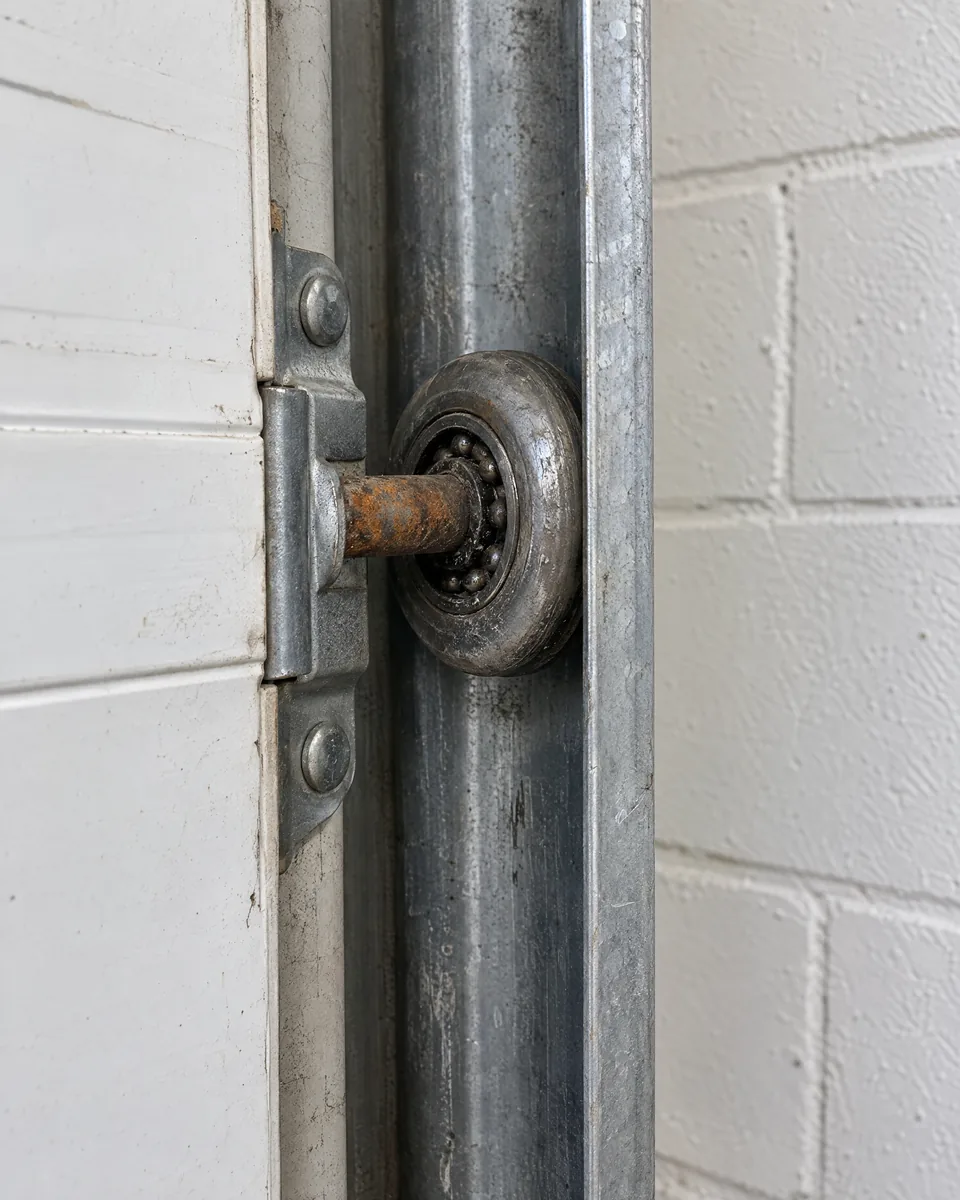
Signs your rollers need replacing
Each side of a sectional door usually has a roller at every joint between sections, plus one at the top and one at the bottom. They turn every time the door moves, and in a coastal climate their bearings and stems sit in damp, salty air.
Signs of worn rollers
- Grinding, squealing or clicking as the door travels.
- Rollers that wobble on their stems or tilt in the track.
- Cracked, chipped or flat-spotted wheels.
- Rust on the stems or around the bearings.
- The door shudders or jerks instead of gliding.
Noises that often come from elsewhere
- A single loud bang from above the door, which points to a spring.
- Chain slap or a straining motor at the ceiling, which points to the opener.
- Squeaky hinges between sections while the rollers still turn freely.
- A rubbing sound only where the track is dented.
From smooth to stuck: how a roller fails
Roller wear is gradual. Catching it early is easier on the rest of the door than waiting for one to leave the track.
- The bearing dries out or fills with grit, and the wheel stops turning freely.
- The wheel starts to slide along the track instead of rolling, and wears a flat spot.
- The stem bends or rusts, so the roller tilts and rubs against the track edge.
- Noise and vibration build, and the opener has to pull harder on every trip.
- A badly worn roller can ride over the lip of the track and take the door off with it.
A door that has already jumped its track needs more than new rollers. See off-track garage door repair for what to do first.
Garage door roller replacement options
Rollers look alike from a distance, but what sits inside the wheel decides how quiet they are and how long they last. Like springs, rollers are often rated in cycles.
Plastic rollers without bearings
The most basic type. The wheel spins directly on its stem with no bearing, so it wears quickly and often cracks or flattens.
Steel rollers
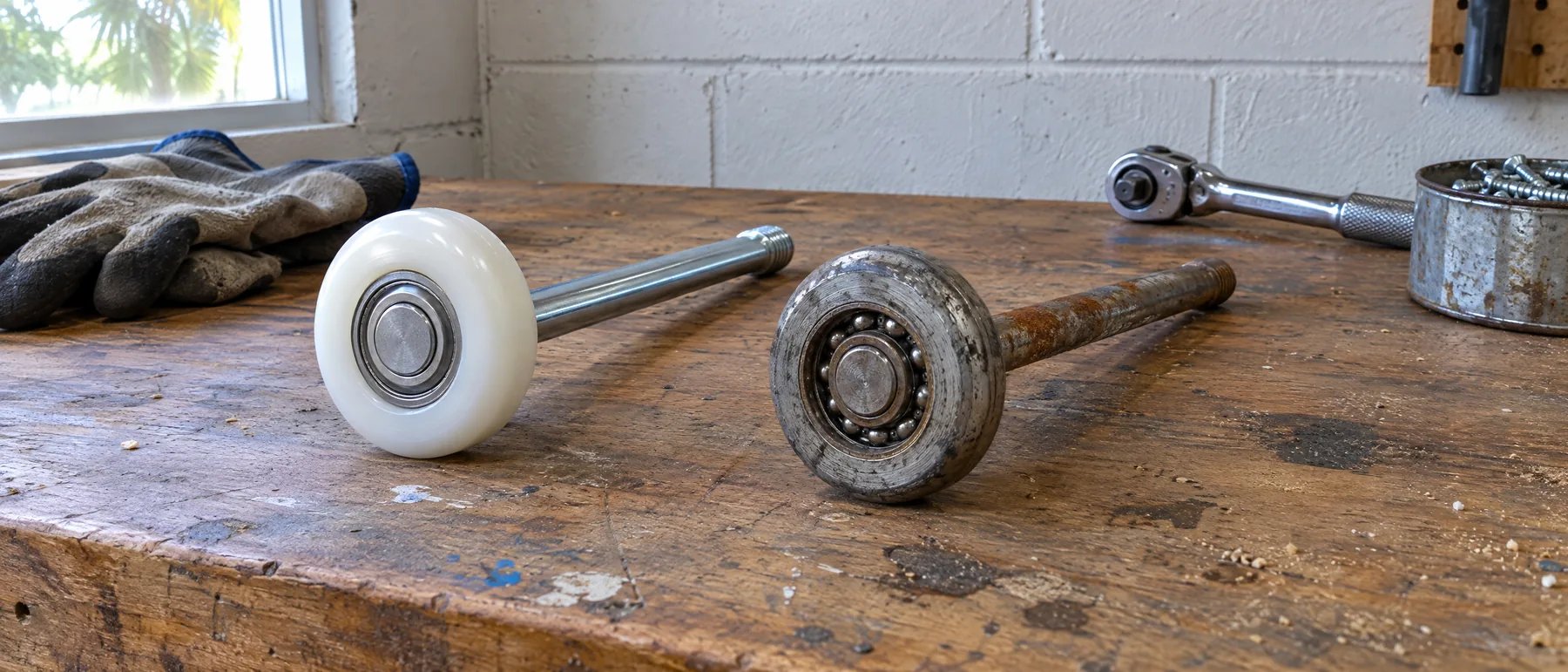
Strong and common on older doors. Steel wheels can be loud, and unsealed bearings and bare stems rust in humid, salty air unless they are kept lubricated.
Nylon rollers with ball bearings
Quieter than steel, with a nylon tire around a ball bearing. The number of balls and whether the bearing is sealed both affect smoothness and lifespan. They are a frequent choice when a quieter door is the goal.
How long rollers last →The bottom rollers are different
The lowest roller on each side sits in the bottom bracket, which is also where the lift cable attaches. That bracket holds spring tension, so the bottom rollers are not a safe swap for a homeowner.
Keeping new rollers healthy
A light spray of garage door lubricant on the roller bearings and hinges a few times a year helps. The tracks themselves should be wiped clean, not greased.
Garage door maintenance →
Wheel, bearing and stem: the three parts of a roller
A roller looks simple, but three parts decide how it runs and how it fails.
The wheel
The part you see turning in the track, made of steel, nylon or plain plastic. Clopay, a door maker, sums up the trade-off well. Steel rollers are more durable but can be noisy, and nylon rollers are quieter and need less maintenance.
The bearing
It sits inside the wheel and lets it spin on the stem. A good bearing keeps the wheel rolling instead of sliding. Sealed bearings keep out more dust and damp than open ones, which helps in a garage that sees salty air.
The stem
The steel shaft that slides into a hinge or bracket on the edge of a section. DASMA, the door industry's trade group, calls a roller with a shaft 7 inches or longer a long-stem roller. Long stems go where the hardware holds the roller farther out, such as a double top fixture, which DASMA describes as two top brackets built to take a longer roller shaft.
The stem also slides a little in its hinge as the door rounds the curve. A bent stem can't do that, so the wheel starts to drag and twist in the track.
Garage door roller replacement, position by position
Not every roller on a door sits in the same kind of hardware. Where a roller sits decides how simple it is to change and who should do it.
| Position | What holds it | What to know |
|---|---|---|
| Top roller | The top fixture, a bracket that positions the top guide roller | Moving the fixture changes how the top section closes against the frame. The opener arm usually attaches to the top section close by. |
| Middle rollers | The hinges between sections | DASMA notes these hinges are graduated and numbered so the door sits flush against the jambs when closed. Each one goes back exactly where it came from. |
| Bottom roller | The bottom bracket | On many doors this bracket also anchors the lift cable, which is under spring tension. A technician's job. |
| Long-stem spots | Double top fixtures and some hinges | A standard stem fitted where a long one belongs can pull out of its hinge as the door moves. |
Swapping hinges between positions is a common mistake when rollers are changed at home. The numbers stamped on them are there for a reason.
Reading an old roller so the new one fits
If a middle roller has already fallen out, or a broken one is lying on the floor, it tells most of the story. Note these details before ordering parts or calling.
- The width of the wheel across its face. It has to suit the track it runs in.
- The stem length, measured from the back of the wheel to the tip. Anything 7 inches or longer is a long stem in DASMA's terms.
- The stem thickness, so it slides freely in the hinge tube.
- The wheel material, and whether the bearing is open or sealed.
- Any number stamped on the hinge or bracket it came from.
A heavier door puts more load on every roller. If your door has several struts across the back, mention it, because that weight affects which rollers suit it.
Worn rollers make the opener work harder. Don't turn it up.
A door on rough rollers drags, and the opener feels it. It may stop or reverse partway down for no clear reason. The tempting fix is to raise the opener's force setting. Chamberlain, an opener maker, warns against exactly that. Its guidance is never to use force adjustments to make up for a binding or sticking door, and to test the door's balance before adjusting anything.
DASMA's homeowner checklist gives a simple way to tell whether the door itself is the problem. With the door fully closed, the opener is disconnected and the door is moved by hand. DASMA also cautions that a door can start to move unexpectedly once the opener is released, so stand clear and keep fingers away from the section joints. Then ask:
- Does the door move freely, without sticking, and not faster than you are pushing it?
- Do the rollers stay in the track the whole way up and down?
- Does the door stay put when left 3 to 4 feet off the floor?
If any answer is no, or a roller is clearly cracked or seized, stop there and book a repair. The balance test guide has more detail, and opener repair covers faults on the motor side.
Rollers through a South Florida hurricane season
The Atlantic hurricane season runs from June 1 to November 30. A few roller checks fit neatly into storm prep.
Before a storm
Rollers that turn freely matter most when the power goes out, because a door on seized rollers is much harder to lift by hand. See opening a garage door without power and hurricane prep for the garage door.
After a storm
Wind-driven rain and sand collect in the bottom of the vertical tracks. Wipe them out before running the door, and look for rollers that have shifted or tilted in their hinges.
Through the season
Damp, salty air goes after bare steel first: steel wheels, open bearings and stems. Orange rust at the hub of a steel roller usually means the bearing inside has started to roughen too.
Choosing replacements near the coast
Sealed bearings and nylon wheels cut down the number of places salt can reach. Ask about the stem as well, since it stays exposed whatever the wheel is made of. Salt air protection covers the rest of the door.
Describing roller trouble so the right parts come
Rollers are small, so a clear description helps. With the door closed and the opener unplugged, count and note what you can see.
- How many rollers are on each side. Count the hinges and brackets along one edge of the door.
- Whether the wheels are steel, nylon or plain plastic.
- Which rollers look bad, top, middle or bottom, and on which side.
- What the noise sounds like and where it happens: near the floor, at the curve, or along the ceiling.
- Whether any roller has left the track. If one has, stop using the door and say that first.
- Whether the door has struts across the back, since they add weight.
Momentum takes calls 24 hours a day, 7 days a week on (954) 636-6320. If a roller is already out of the track, read off-track garage door repair before anything else. For a door that is noisy but rolls fine, garage door maintenance may be the better fit.
Roller questions
Is it worth replacing garage door rollers?
Usually, yes. Rollers are small parts, and worn ones make the door louder, rougher and harder on the opener. Fresh rollers can make an older door noticeably quieter, and they lower the chance of the door riding out of the track.
Should all the rollers be replaced at once?
When one has worn out, the others have done the same work. Replacing the full set gives an even ride along both tracks, though a single broken roller on a newer door can be swapped on its own.
Do salt air and humidity affect rollers?
They do. Moisture and salt speed up rust on steel stems and unsealed bearings. Rollers with sealed bearings tend to hold up better in damp air, and regular cleaning and lubrication help any type.
Can I change rollers myself?
Rollers on the middle hinges are sometimes changed by experienced DIYers, one at a time with the door closed and the opener unplugged. The bottom rollers are a different story, because their brackets hold the lift cables under spring tension. If in doubt, call (954) 636-6320.