Emergency Garage Door Repair
A snapped spring at night, a door stuck open before a storm, a car trapped inside on a workday morning. Momentum takes emergency garage door repair calls 24 hours a day, 7 days a week, in Bal Harbour and the cities north of it.
(954) 636-6320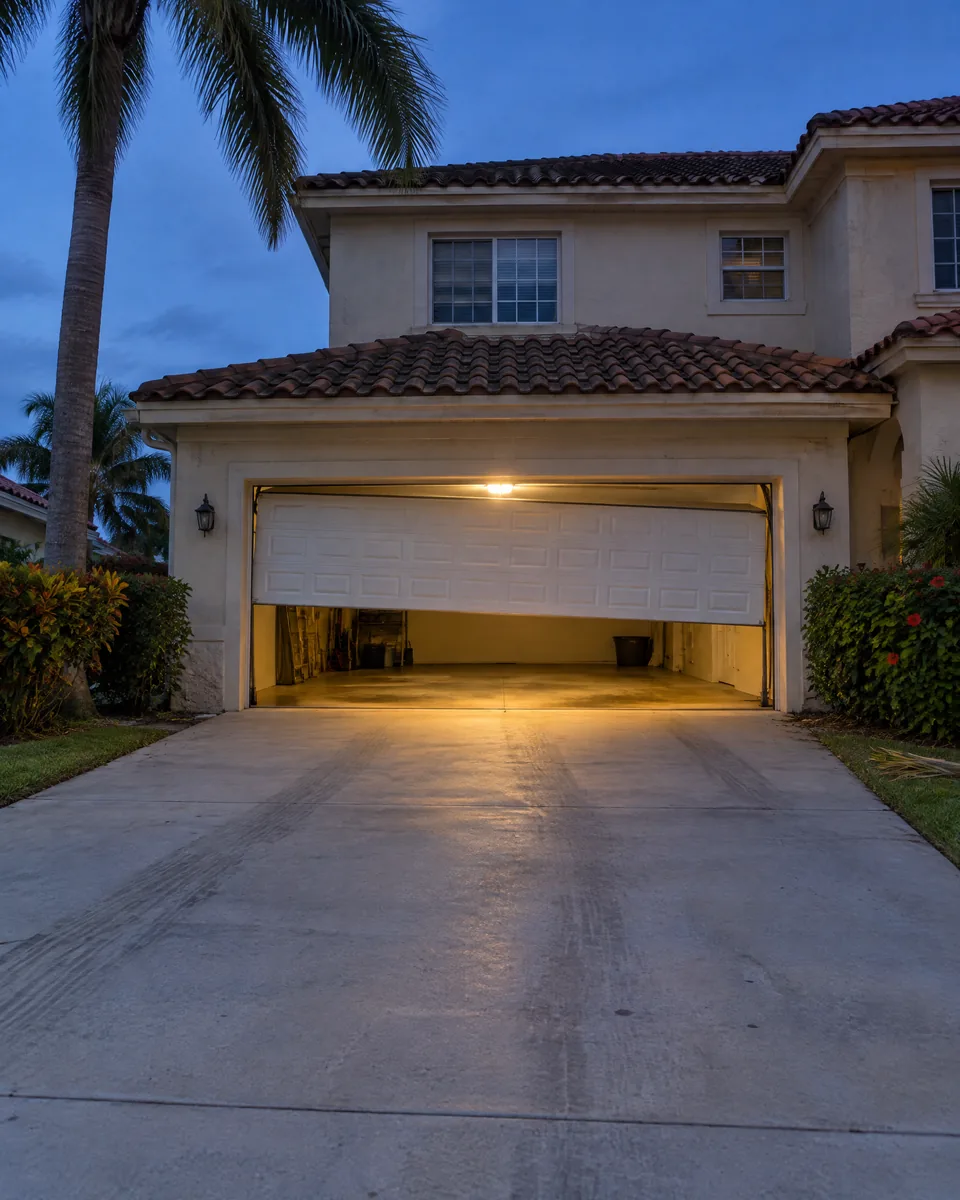
Call now, or book a visit?
Not every garage door problem needs a call in the middle of the night. These lists can help you decide. If you're unsure, call and describe what the door is doing.
Call now if
- The door is stuck open and the house can't be secured.
- A car is trapped inside and you need it.
- A spring or cable has snapped and the door hangs or sits crooked.
- The door came off its track or a panel has buckled.
- A storm is coming and the door won't close.
It can usually wait for a booked visit if
- The door still opens and closes but is noisy.
- It moves slowly or shudders on the way up.
- The remote works only from close range.
- A bottom seal is worn or a small dent has appeared.
Keep it safe until the door is fixed
A garage door is the largest moving object in most homes. When a part fails, the safest thing is usually to stop moving it.
- Clear the area. Keep children, pets and cars away from the door and out of its path.
- If you heard a bang, or a spring has a gap in it or a cable hangs loose, stop pressing the remote and the wall button.
- Leave the springs, the cables and the brackets at the bottom corners alone. They carry the door's weight under heavy tension.
- Use the manual release only once the door is all the way down. On a door with a broken spring, releasing it while it is open can let it slam shut.
What usually goes wrong
Broken spring
The door won't lift, or rises a few inches and stops. Many people hear a loud bang first.
Spring repair →Snapped cable
One side of the door drops, or the door hangs crooked in its opening.
Cable repair →Off its track
Rollers have come out of the track, and the door is jammed or leaning.
Off-track repair →Won't close
The door reverses before it reaches the floor, or doesn't respond at all.
Sensor repair →
Emergency garage door repair: match the symptom to the fault
Most garage door emergencies come from a short list of failures. This table shows what each symptom usually points to, and whether the door should be moved at all before it is looked at.
| What you see | Likely cause | Move the door? | Read more |
|---|---|---|---|
| A loud bang, then the door won't lift past a few inches | Broken torsion spring | No. Leave it where it stopped. | Spring repair |
| One corner low, door tilted in the opening | Snapped or slipped lift cable | No | Cable repair |
| Rollers out of the track, door leaning or jammed | Door off its track, often after a cable failure or a knock | No | Off-track repair |
| Door reverses just before it reaches the floor | Safety sensor blocked, dirty or out of line | Yes, once the beam is clear | Sensor repair |
| Opener hums or clicks, door doesn't move | A broken spring, or an opener fault | Look at the springs first | Opener repair |
| Opener light blinking, door won't close | The opener reporting a fault, often the sensors | Read the blink pattern first | Blinking light guide |
| Power is out and the door is closed | No fault, just no power | By hand, if the springs are whole | Power-outage guide |
When the door won't close and a storm is on the way
The Atlantic hurricane season runs June 1 through November 30, and the National Hurricane Center puts its peak around September 10. A garage door stuck open during a hurricane watch is more than a security problem.
FEMA's brochure Against the Wind, written after Hurricane Andrew, lists the garage door as one of four parts of a home to check for weakness, with the roof, the windows and the doors. It explains that wide two-car doors can wobble in high wind, pull out of their tracks or collapse, and that wind entering through a failed garage door can blow out doors, windows, walls and even the roof.
- On a door that still runs, grab each vertical track with both hands. The FEMA brochure suggests this check: a track that is loose or twists needs attention.
- Clear the path under the door and in front of both safety sensors, so a bin or a hose doesn't stop the door closing.
- If the door closes and then reverses, check the sensor lights before assuming a bigger fault.
- If a spring or cable has failed, don't force the door down by hand or with the opener. Call and say that a storm is coming.
Getting a garage door ready for hurricane season covers the checks worth doing well before a storm is named.
Outages, generators and the garage
Storms and outages tend to arrive together, and the garage is where many people keep a portable generator. Three safety points matter here.
Never run a generator in the garage
The U.S. Consumer Product Safety Commission says never to run a generator inside a home, garage, basement, crawlspace or shed, and its materials warn against it even in a garage with the door open. Run it outside, well away from windows, doors and vents.
Release the opener with the door closed
Under the federal opener rule, owner's manuals tell users to pull the emergency release only when the door is closed, if possible. A door with a broken spring can fall the moment it is freed from the opener.
Stop if the door feels like dead weight
Once released, a balanced door should move by hand without a struggle. If it won't budge, or drops when you ease off, a spring has probably failed. Leave it and call.
The full manual steps are in the power-outage guide.
A car shut in behind a broken door
A car shut inside is the situation that tempts people to force a door. With a broken spring, the full weight of the door sits on whoever lifts it, and the opener isn't built to do the springs' job either. A door raised partway can come down without warning.
The U.S. Consumer Product Safety Commission's test for a healthy door is that it stays put when stopped partway open. A door that won't do that is one to stay out from under.
- Sort out another way to get where you need to be before you think about the door.
- Don't prop a broken door open with a ladder, a block of wood or a car jack.
- Don't walk or drive under a door that is hanging crooked or partly raised.
- Tell the person you call that a car is inside, and when you need it.
What to say when you call at night
A clear description helps the person on the phone work out what has failed. Have these details ready:
- The address, and any gate code or building access instructions.
- What happened, in order: a bang, a jolt, a grinding noise, or nothing at all.
- Where the door is now: closed, open or stuck partway, and whether it sits level.
- Whether anyone was hurt, or a car is blocked in.
- Whether it is a single or double door, and whether the springs sit above the door or along the ceiling tracks.
- The opener brand, and whether it is still connected to the door.
- Photos of the springs and both bottom corners, taken from a safe distance, in case they are asked for.
Momentum answers calls 24 hours a day, 7 days a week on (954) 636-6320.
Checks worth doing after any emergency repair
An emergency repair fixes the part that failed. These checks, taken from federal safety guidance, confirm the rest of the door still protects the people who use it.
The reversal test
Lay a 2x4 flat on the floor in the door's path and close the door. Under the federal opener rule, a closing door must begin to reverse within 2 seconds of contact, and owner's manuals tell users to test this monthly. If it doesn't reverse, CPSC says to disengage the opener until it is adjusted, repaired or replaced.
The sensor height
Openers made since 1993 must have external entrapment protection, such as an electric eye. CPSC says an electric eye should sit 4 to 6 inches above the floor. A sensor knocked out of place during the emergency is worth a look.
The balance
A door in good order stays in place when it is stopped partway open. CPSC warns that a badly unbalanced door could crash to the floor and strike someone under it.
The 30-day look
CPSC recommends inspecting the door and opener every 30 days, mounting the wall button as high as practical and keeping remotes away from children. It has received reports of about 73 children trapped and killed under automatic garage doors since March 1982.
Emergency repair questions
Can I open the door if the spring is broken?
It's better to leave it. Without the spring the door carries its full weight, and lifting it by hand or with the opener can drop it or damage the opener.
What if the power is out?
A door with working springs can be opened and closed by hand with the emergency release. The full steps are in our power-outage guide.
Do you come out at night?
Momentum takes calls 24 hours a day, 7 days a week. Call (954) 636-6320 and describe what the door is doing.