Garage Door Cable Repair
When a lift cable snaps or slips off its drum, one side of the door drops and the whole door hangs crooked in the opening. Momentum offers garage door cable repair across Bal Harbour, North Miami and the surrounding areas, with calls taken 24 hours a day, 7 days a week.
(954) 636-6320
Cable trouble or a different fault?
Lift cables are thin steel wire ropes, yet they carry the door up and down on both sides. A cable problem almost always shows up as a door that sits uneven.
Signs of a cable problem
- One side of the door sits lower than the other when it is closed or stopped partway.
- A cable dangles beside the track or lies coiled on the floor.
- Strands are broken or rusted where the cable meets the bottom corner of the door.
- The cable has jumped off the drum at the top of the door and wrapped unevenly.
- The door jerked, tilted and stopped while it was moving.
Signs the cause is likely elsewhere
- The door is level but won't lift past a few inches. A broken spring is the more likely cause.
- Both cables look tight and intact, but a roller has come out of the track.
- The door is level and quiet, yet the opener won't run it.
Can you open a garage door with a broken cable?
Short answer: no. With one cable gone, the door is supported on one side only. Moving it can twist the sections, bend the track or bring the door down unevenly.
- Stop using the opener and unplug it. The motor keeps pulling even when the door is binding.
- Leave the door where it is, even if it is partly open.
- Keep everyone out of the opening. Nobody should walk or drive under a door that hangs crooked.
- Don't loosen the bottom brackets or tug on a slack cable. On many doors that bracket is still under spring tension.
- If the door is stuck open, lock the door between the garage and the house.
A loose cable is often the first visible sign of a spring that has let go. If the coil above the door shows a gap, read about broken spring repair as well.
Why garage door cables need repair
Cables wear slowly, then fail all at once. These are the usual reasons. Why garage door cables break covers each one in more depth.
Rust at the bottom bracket
The lower end of each cable sits close to the floor, where rainwater, wet leaves and salty air collect. Corrosion weakens the strands there first, often out of sight behind the weather seal.
Fraying from wear
Cables rub against brackets, drums and pulleys every time the door runs. Broken strands that stick out like bristles mean the cable is losing strength.
Slipped off the drum
A cable that goes slack can unwind off its drum. That happens when a spring breaks, or when the door catches on something while closing and the cables lose tension.
A door knocked off its track
A door that drops on one side can push rollers out of their tracks. If yours is leaning or jammed, it may need off-track repair too.
Off-track repair →Why both cables are usually replaced
Both cables have done the same work in the same air. When one fails, the other usually shows similar wear. Replacing the pair keeps their lengths matched, so the door lifts level.
Where each end of the cable attaches
A lift cable is a short length of wire rope with a fitting at each end. Where those ends go depends on which spring system the door has.
At the bottom bracket
The lower end loops over a pin or stud on the bottom corner bracket. DASMA describes the clevis pin, held with a cotter pin, as one way the cable is fixed there. The same bracket holds the bottom roller, so it carries a lot of load.
On a torsion drum
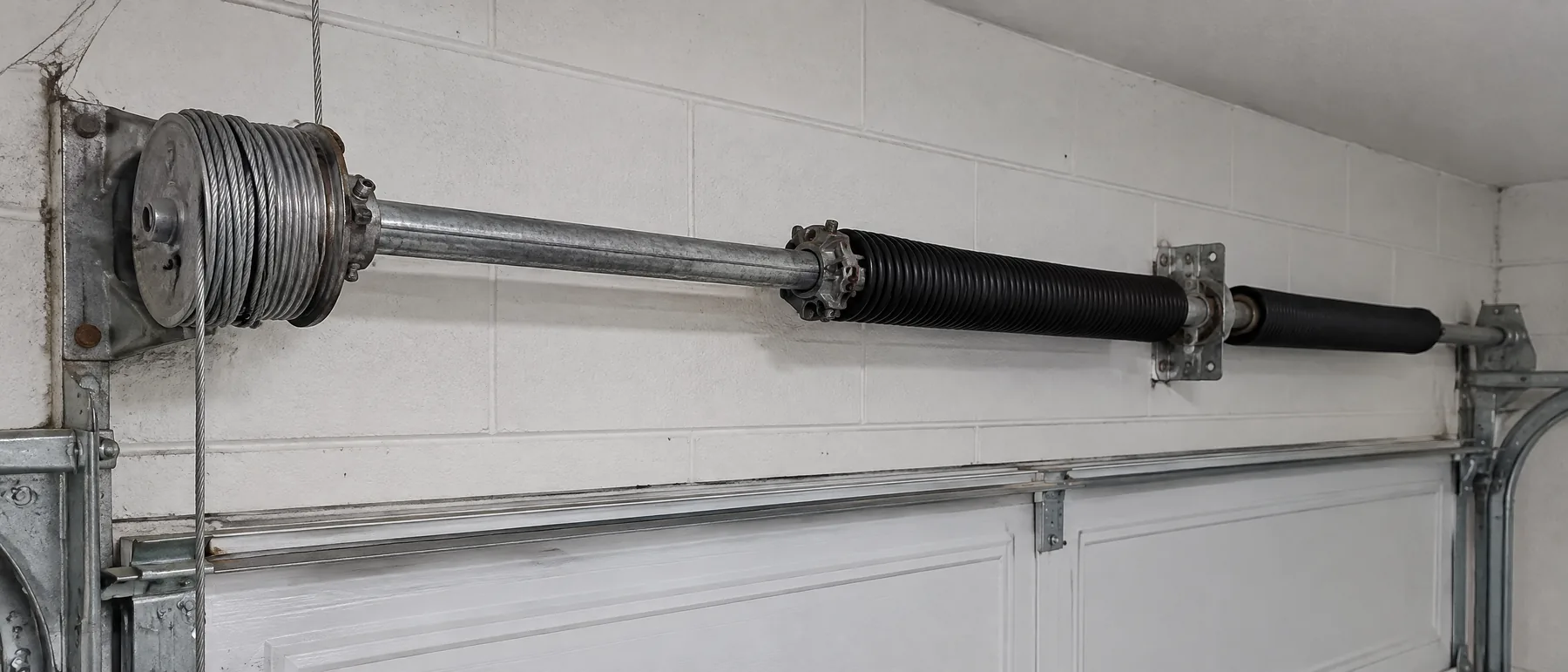
The upper end has a swaged fitting called a cable stop, which sits in a slot in the drum. As the door rises, the cable winds into the drum's grooves. Set screws lock the drum to the shaft, and one may also hold the cable at its set length.
On an extension-spring door
There are no drums. The cable runs from the bottom bracket over pulleys, called sheaves, one of which hangs from the spring on a yoke called a sheave fork. It ends at a three-hole clip that lets the length be adjusted.
Inside or outside the track
On an inside hook-up the cable runs between the door sections and the vertical track. On an outside hook-up it runs outside the track. The bottom bracket is made for one or the other, so it has to match.
Extra cables on wide doors
Very wide or heavy doors can have a center lift cable, fixed toward the middle of the door, for added support. It is easy to miss when looking for the cause of a sag.
Garage door cable repair by the numbers
Cables look simple, but the American National Standard for sectional doors, ANSI/DASMA 102, sets clear limits on them and on the parts they connect to. Those limits are why garage door cable repair is about matching parts, not just finding a wire that reaches.
| Part | Requirement | What it means at home |
|---|---|---|
| Cable assembly | Selected with a safety factor of 5 | A new cable is chosen to hold several times its working load. Fraying and rust eat into that margin. |
| Cable diameter | No more than 5% of the diameter of the drum or sheave it runs on | A thicker cable isn't automatically safer. It has to suit the drum. |
| Cable drums | Wind and pay out cable in an orderly way, without lapping or chafing, with a safety factor of 4 | Cable that overlaps itself on the drum is a warning sign. |
| Bottom brackets | Hold their share of the door's static load with a 4 to 1 safety factor | The bracket is a load-bearing part, not trim. |
| Cable ends | Securely anchored at each end | A cable slipping at a fitting needs attention, even if the wire looks fine. |
DASMA's glossary describes garage door cable as aircraft-type cable: several strands of galvanized wire rope braided together. Galvanizing is a zinc coating that protects steel from corrosion. Once that coating wears through, usually at the bottom end, rust starts on the bare steel.
Why a replacement cable has to match the door
A cable isn't simply cut to fit. Its length, and the drum it winds onto, are part of how the door is balanced.
Cable length
DASMA lists cable length as the specific amount of cable a door needs to operate properly. If one side ends up shorter than the other, the door rises unevenly and the short side takes more of the load.
Standard, high-lift and vertical-lift drums
A standard door uses standard drums. A high-lift door, where the track rises some distance above the opening before it turns, uses a drum contoured for that. Vertical-lift doors use drums with changing-radius grooves. A cable set up for one drum won't balance a door built around another.
Lapping and chafing
Drums are designed to stop cable lapping over itself. Cable riding out of its grooves, or bunched at one end of the drum, usually means it went slack at some point.
Two drums, one shaft
On a torsion system both drums turn on the same shaft. If the cables aren't wound to the same tension, the door hangs low on one side even with brand-new cable.
The safety hardware near your cables
Some of the hardware near the cables is there only to keep a failure from becoming an injury. It helps to know what you are looking at before anyone touches it.
- Containment cable. On extension-spring doors, a cable threaded through each spring holds it if it breaks. ANSI/DASMA 103 requires springs to be restrained, and tests extension spring restraints by cutting the spring apart at full stretch.
- Broken cable device. Some doors have a bottom fixture designed to slow or stop the door if a lift cable breaks. Not every door has one.
- Red fasteners and warning decals. One way ANSI/DASMA 103 allows tensioned parts to be protected is red fasteners, with warning decals at the bottom corner brackets. A red bolt at the bottom of the door is holding spring load. Don't loosen it.
- The opener manual warning. The federal opener rule, 16 CFR Part 1211, requires the owner's manual to say that a qualified service person should repair cables, spring assemblies and other hardware.
A cable check you can do from the floor
The U.S. Consumer Product Safety Commission recommends looking over the door and opener every 30 days. For the cables, that look takes a minute, with the door closed and nobody touching the hardware.
- Stand back and compare the two cables. They should look equally tight.
- Look at the lowest few inches of each cable, near the bottom bracket, for broken strands, kinks or orange rust.
- Look up at each drum. The cable should sit in the grooves in a neat spiral, not lapped over itself.
- Check that the bottom of the door meets the floor evenly, with no gap on one side.
- On an extension-spring door, check that a containment cable runs through each spring.
If anything looks wrong, stop using the opener and call (954) 636-6320. Say which side looks wrong, whether the door is up or down, and whether the springs sit above the door or along the ceiling tracks. Momentum answers 24 hours a day, 7 days a week.
On the coast, the bottom of each cable sits close to the driveway, where rainwater and salt settle. During hurricane season, which runs June 1 through November 30, that end of the cable is worth a look after every big storm, before the door is run again.
Cable repair questions
What happens if a garage door cable breaks?
The side with the broken cable loses its support, so that corner drops. The door usually tilts, binds in the track and stops. On a torsion system the spring may still be wound, which is why the brackets and cables shouldn't be handled.
Is a lift cable the same as the cable inside an extension spring?
No. Lift cables raise and lower the door. A safety cable runs through the middle of an extension spring to contain the spring if it snaps. Both matter, and a missing safety cable on an extension-spring door is worth fixing.
Can a slipped cable go back on the drum instead of being replaced?
Sometimes a cable that slipped off without damage can be rewound and re-tensioned. A cable with broken strands, kinks or rust should be replaced. Either way it is spring-tension work, not a homeowner job.
Can I call outside normal hours?
Yes. Momentum can be reached by phone 24 hours a day, 7 days a week. Call (954) 636-6320 and say which side of the door dropped.