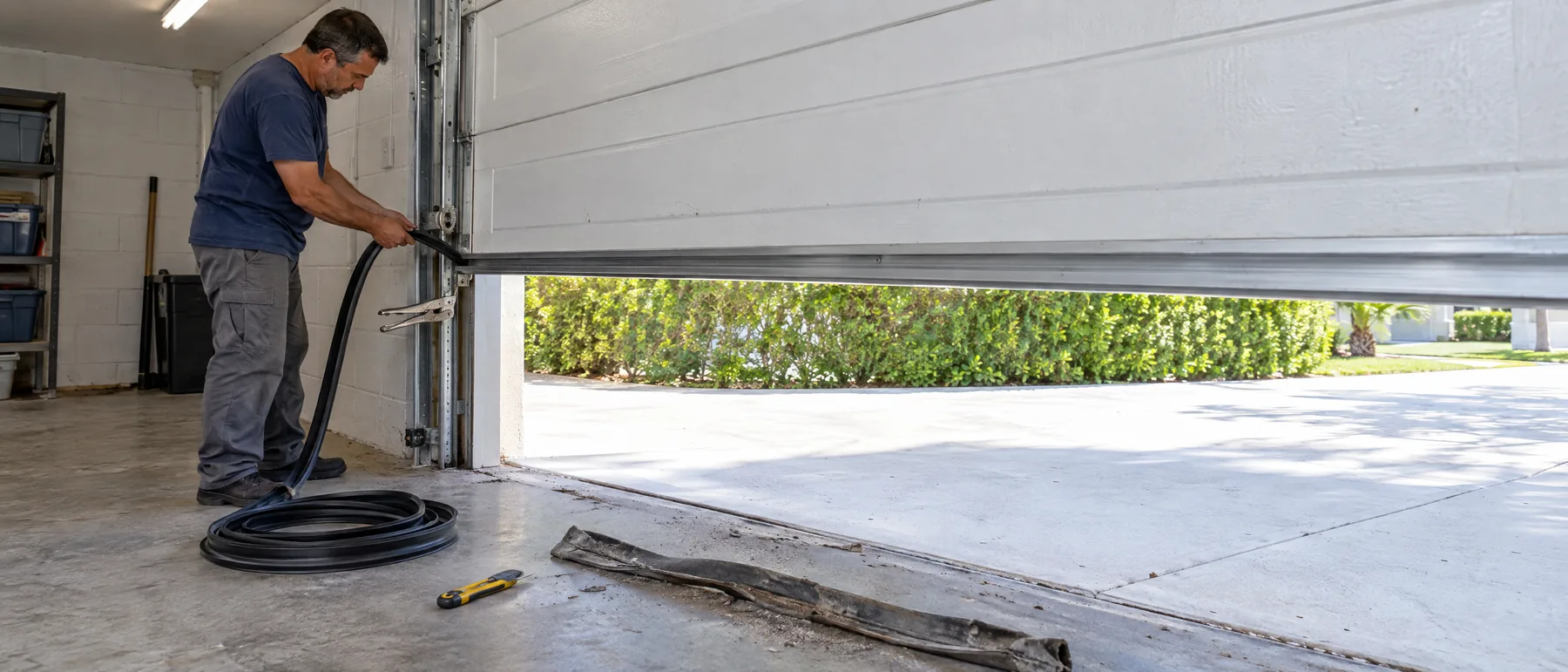
To replace a garage door bottom seal, raise the door to a comfortable working height, secure it so it can't move, slide the old rubber out of the channel along the bottom edge and feed a new strip in. On most steel doors it takes a few hand tools and a second pair of hands, and none of it involves the springs.
The tricky part is usually buying the right seal. Bottom seals come in several shapes, and a strip that doesn't match the channel on your door simply won't go in. Work out what you have first, then buy the part, then do the swap.
A worn seal lets in rain, dust, leaves and insects. It is also one of the few garage door jobs most homeowners can handle safely, as long as they stay away from the hardware at the bottom corners.
Signs your bottom seal needs replacing
A bottom seal is a strip of rubber or vinyl that squashes against the floor when the door closes. Heat, sunlight and the weight of the door wear it down over the years. Look for:
- Daylight under the closed door, especially near the corners.
- Water, leaves or grit blowing in after a storm.
- Rubber that is cracked, flattened, stiff or torn.
- A loose end hanging out of the channel.
On a sunny day, close the door and switch off the garage light. Any line of light along the floor shows where the seal no longer touches.
How to tell which garage door seal you need
Pull one end of the old seal a few inches out and look at how it's held on. Most steel doors use a retainer, a metal channel screwed along the bottom edge with slots running its full length. Wood doors often have a flat strip nailed or screwed straight to the bottom instead.
Retainer seals are sold by the shape of the edge that slides into the slots:
- T-style seals have flat, T-shaped edges that slide into straight slots.
- Beaded seals have rounded edges that fit rounded slots.
- J-type seals hang from a hooked, J-shaped retainer.
The rubber below the edges may be a single loop, often called a bulb seal, or a flatter shape. Measure the width of the door, and cut a short piece off the old seal to take with you when you shop. If the edge shape or size is even slightly off, the new strip either won't feed in or will pull out the first time it drags on the floor.
Replacing the bottom seal in a retainer
Two people make this much easier. One feeds the new seal in while the other pulls it along.
- Raise the door to about waist height and unplug the opener so nobody can run it while you work.
- Clamp the tracks. Fasten locking pliers onto each vertical track just below the bottom rollers. While the opener is still connected it holds the door in place, and the pliers stop the door coming down if someone pulls the release cord by accident. Leave the cord alone.
- Slide out the old seal. Some retainers are pinched at the ends to hold the seal in. Open them gently with a flat screwdriver, then pull the rubber out of one end.
- Clean the slots. Wipe out grit and bits of old rubber. A light mist of soapy water or silicone spray helps the new seal glide.
- Feed in the new seal. Line both edges up with the slots at one end, then push while your helper pulls. Keep the strip straight so it doesn't twist.
- Trim the ends. Cut the seal with a utility knife so it finishes about flush with each side of the door, or as the packaging suggests. Pinch the retainer ends closed again if they were pinched before.
- Remove the pliers, plug the opener back in and close the door. Check again for daylight along the floor.
When the seal isn't the problem
A crooked door, a frayed cable or a door that won't stay where you leave it needs a repair, not new rubber. Momentum covers garage door repair in Hallandale Beach.
Hallandale Beach repairsThe parts near the floor you shouldn't touch
At each bottom corner of the door sits a bottom bracket. The lift cable attaches to it, and the springs keep that cable under heavy tension. Loosening a bottom bracket can let the cable and bracket fly loose with real force.
That matters because replacing a bent or corroded retainer, not just the rubber, often means removing fasteners close to those brackets. If the retainer itself is damaged, or the screws near the corners are seized, leave that part of the job to a garage door technician.
The same goes for a gap that is much wider on one side. A new seal can't make up for a door that hangs crooked, and a slanted bottom edge often points to a cable or spring problem rather than worn rubber. Garage door cable repair covers what can pull a door out of level. A floor that dips in one spot can also leave a gap no seal will close.
If the door feels heavy, or won't stay where you leave it when it is moved by hand, the springs may be part of the story. The garage door balance test shows how to check that safely.
Garage door weather stripping and coastal weather
The bottom seal is one piece of the door's weather stripping. Many doors also have strips along the sides and top of the opening, fixed to the frame. Those wear the same way and are worth checking at the same time.
Near the coast, seals and the metal around them have a harder life. Sun and heat break down rubber and vinyl, and salt air and humidity speed up corrosion of steel hardware. South Florida's hurricane season runs June 1 through November 30, and wind-driven rain gets under a worn seal quickly, so a check before the season starts is a good habit. For more on coastal wear, see protecting a garage door from salt air.
If you're in Hallandale Beach and the gap turned out to be a door that sits crooked or won't stay put, Momentum can help with repairs to your Hallandale Beach garage door.