Garage Door Opener Installation
Picking a new opener is a different decision from fixing an old one. The drive, the lifting power, the backup battery and the safety sensors all have to suit the door you already have. Momentum offers garage door opener installation on existing doors in Bal Harbour, North Miami and the surrounding areas.
(954) 636-6320
Is your door ready for a new opener?
An opener moves a door that the springs already hold in balance. If the door is heavy, binding or crooked, a new motor will strain against it and wear out early. These lists show which side your door is on.
Ready for a new opener if
- The door lifts by hand with steady, even effort.
- Rollers turn freely and the tracks are straight.
- Both cables look intact and the door sits level when closed.
- There is a working outlet near where the new unit will hang, or on the wall beside the door for a wall-mount unit.
- The current opener is old, loud or missing features you want.
Hold off and check first if
- The door feels very heavy or drops quickly when lowered by hand.
- One side sits lower than the other or a cable looks frayed.
- The door rubs, jerks or grinds on the way up.
- The old unit might only need a part. Opener repair can be the simpler path when the motor is still sound.
The stages of a typical opener installation
Installers each have their own routine, but most opener installations pass through the same stages. Knowing them helps you understand what the job involves.
- The door is checked first. It should be balanced and move freely, because an opener isn't meant to lift dead weight.
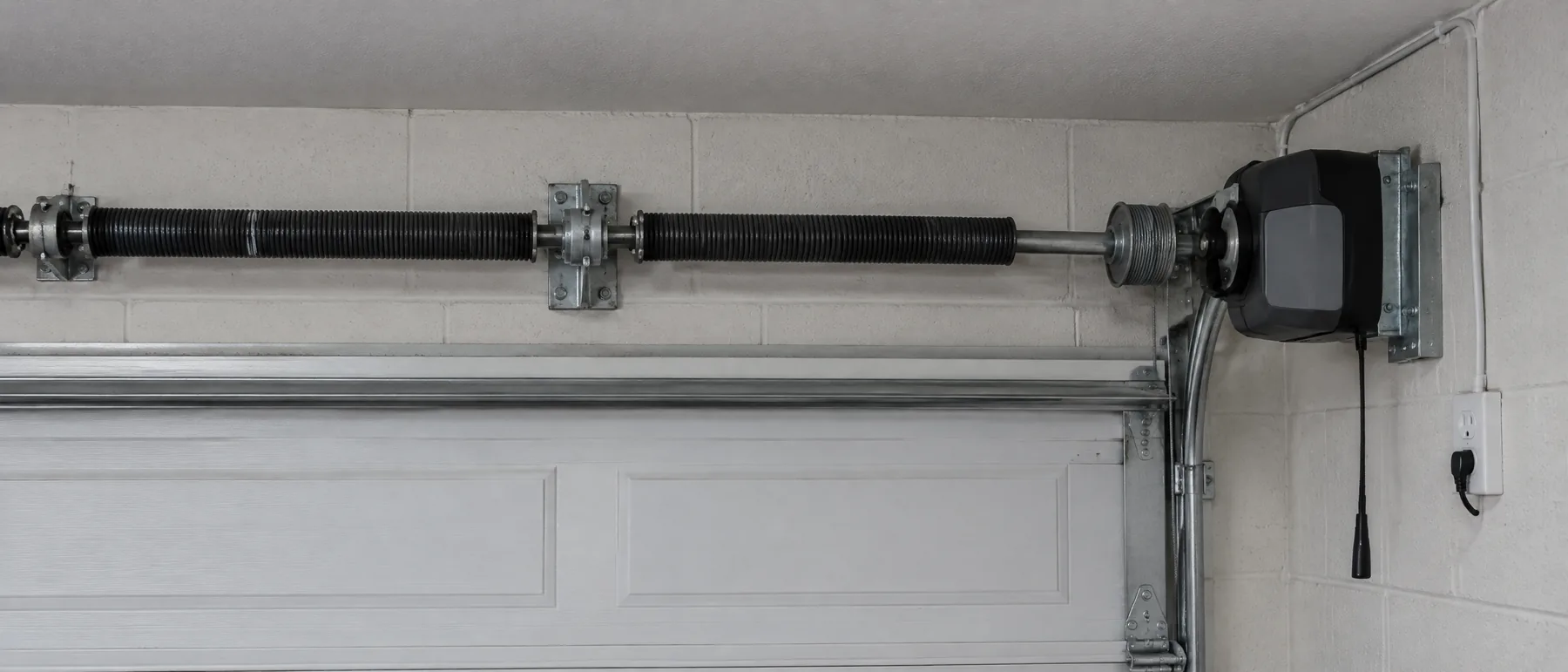
- The rail is fixed to a header bracket above the door and hung from the ceiling, or a wall-mount unit is fitted beside the door on the spring shaft.
- The two safety sensors go on either side of the opening, a few inches above the floor, aimed at each other and wired back to the motor.
- Travel limits are set so the door stops fully open and closes snug to the floor without pushing.
- Remotes, the wall control and any keypad are paired with the new unit.
- The safety reverse is tested, so a door that meets something on the way down stops and goes back up.
Keep the owner's manual somewhere easy to find. It explains pairing and the limit settings for that exact model.
Which garage door opener installation fits your garage?
The drive is the part that moves the trolley along the rail. It decides most of the noise, the upkeep and where the unit sits. Power and rail length then have to match the door.
Chain drive
A metal chain pulls the trolley. Sturdy and common, but the loudest of the group, which matters when a bedroom sits over the garage.
Belt drive
A reinforced rubber belt does the chain's job with far less noise and vibration. A popular pick for attached garages.
Screw drive
A threaded steel rod turns to move the trolley. It has fewer moving parts than a chain, though it is usually noisier than a belt.
Wall-mount
Sits beside the door and turns the torsion spring shaft directly. It frees up the ceiling, but it needs a door that uses torsion springs.
Power and rail length
Heavier doors call for more lifting force, and taller doors usually need a longer rail or an extension kit.
Sizing an opener →
What the door has to pass before an opener is fitted
The door industry's trade group, DASMA, publishes a checklist for a door that is about to get an opener. It goes well past balance. Here is what it asks for, in plain words.
- The panels show no fatigue, cracking or separation.
- The door's own warning labels are still on it.
- Springs and hardware are secured, and the springs are held by a cable or a shaft so a break can't fling them.
- There are handles or grip points inside and out. The door moves freely, doesn't open faster than you push it, and its rollers stay in the track.
- Every rope is gone, and any lock connected to the door is removed or made inoperative. A locked door fighting an opener damages both.
- The top section is reinforced, both across and up and down, so the opener arm doesn't bend it. DASMA says to ask the door's maker or a trained technician when in doubt.
- The door sits level with the floor. A gap at one end stops the reversal systems from working across the full width.
A door that fails one of these is fixed first. A weak spring goes to spring repair, and worn rollers or loose hardware to maintenance. Genie's manual puts it in one line: do not install an opener on an improperly balanced door.
Garage door opener installation: the measurements that are set for you
The federal opener standard, 16 CFR Part 1211, lists what the installation instructions must tell the installer. DASMA adds the spacing for the photo eyes. These figures apply whatever brand goes up on the ceiling.
| Item | What is required |
|---|---|
| Wall control | Within sight of the door, at least 5 feet above floors, landings or steps, and away from all moving parts |
| Opener | 7 feet or more above the floor where possible |
| Emergency release | Within reach but at least 6 feet above the floor, placed so a vehicle won't catch it |
| Warning labels | The entrapment warning next to the wall control, and a marking on or next to the release |
| Photo-eye height | Beam no higher than 6 inches above the floor |
| Photo-eye position | Within 6 inches of the door's path, usually no more than 20 feet apart unless the maker allows more |
| Reversal after installing | The door must reverse on a 1-1/2 inch object, a 2x4 laid flat |
Two doors with two openers need two sets of sensors. Chamberlain tells installers never to share one pair between doors.
Outlets, hard wiring and battery backup
An opener draws its power from the ceiling, so the outlet up there matters. Genie's manual is blunt about it. The opener has a grounded plug, the plug must not be altered, and an extension cord must never be used. With no grounded outlet, the manual says to have a licensed electrician install one. It also tells owners to check local building codes in case a permanent hard-wired connection is required, and that work belongs to a licensed electrician too.
Battery backup, in real numbers
Backup units differ by brand. Genie's manual, as one example, calls for a 12-volt, 5 amp-hour sealed lead-acid battery. It says to charge it for 48 hours before the first test, and notes that on battery the opener runs at reduced speed with the work light off.
Testing the backup
The same manual lists a monthly test. Unplug the opener and run it from the remote or wall console. A battery that can't move the door on a calm day won't move it in a storm.
One state made it law
DASMA notes that California has required battery backup on residential openers sold or installed there since July 1, 2019. That says a lot about how outages and garage doors mix. With a long hurricane season here, it is a feature worth weighing before choosing a model.
Ceiling-mount or wall-mount on the door you already have
The drive type mostly changes noise, and the sizing guide covers that along with power. The mounting decides something more basic: whether the opener suits your door and your garage at all.
| Ceiling-mount (chain, belt, screw) | Wall-mount (jackshaft) | |
|---|---|---|
| Where it sits | On a rail running back from the header above the door | On the wall beside the door, turning the spring shaft |
| Door it needs | A balanced sectional door | A sectional door with front torsion springs, per Genie's wall-mount manual |
| Ceiling | Needs clear space for the rail and motor | Leaves the ceiling free |
| Taller doors | Rail extension kits are sold for 8-foot and 10-foot doors | Set up through the model's drum settings |
| First close | Runs at its normal speed | Genie's unit moves in small steps at first to sense cable tension, then runs normally |
Genie's wall-mount manual also has the installer choose a drum setting: standard drums of 4 inches or less, or high-lift and vertical-lift drums larger than 4 inches. A garage with high-lift track needs that choice made correctly for the opener's force profile to work.
Phone control and timer-to-close, and the rules behind them
Closing a door from a phone, or letting it close itself on a timer, means nobody may be standing there to watch it. DASMA explains that the UL 325 standard was revised in 2009 to allow these unattended features, and federal rules followed. Three conditions come with them.
- The opener must have a secondary entrapment device, such as photo eyes.
- The feature may only work on a sectional door.
- The opener must give an audible and visual warning for 5 seconds before the door moves.
That 5-second warning is the beeping and flashing owners notice the first time they close the door from an app. It isn't a fault. Chamberlain's buyer's guide also notes that its app control needs an opener with built-in Wi-Fi, so check the model before counting on phone control. If a door closed from the app keeps reversing, look at the sensors first. Sensor repair covers what to check.
A first-year maintenance schedule for a new opener
Every new opener ships with a manual, and most manuals include a schedule. DASMA asks installers to leave that manual with the homeowner, so keep it near the wall control. Genie's belt and chain manual shows what a typical schedule covers.
| Check | How often | What it involves |
|---|---|---|
| Contact reverse test | Monthly | The 2x4 test under the closing door |
| Safety sensors | Monthly | Look for loose connections and cracked or worn insulation, and clean the lenses |
| Door balance | Monthly | With the opener released, lift the door 3 to 4 feet and let go. It should stay put or drift down slowly |
| Battery backup | Monthly | Unplug the opener and run it on the battery |
| Chain or belt | Yearly | Look for excess slack and adjust it as the manual explains |
| Remote batteries | As needed | Replace when the range starts to drop |
Salt film on sensor lenses and bare metal builds faster in a coastal garage, which makes those monthly checks worth keeping. Protecting a door from salt air covers the door side of that.
New opener questions
Is a battery backup worth it in South Florida?
It's worth weighing. Hurricane season runs from June 1 to November 30, and a storm can knock out power for hours or days. A backup battery lets the opener run a limited number of cycles during an outage. Without one, the door has to be opened by hand. Opening a garage door without power walks through how.
What affects the cost of a new opener?
The drive type, the motor's power, phone or smart control, a battery backup and whether there is already an outlet near the opener. Taking down the old unit and adding rail length for a tall door also play a part.
Will my old remotes work with the new opener?
Often they won't. Many newer openers use rolling-code remotes that change their code with each press, and older remotes may not pair with them. Programming a garage door remote covers pairing in general.
Can a new opener fix a door that's hard to lift?
No. The springs carry the door's weight. On an unbalanced door the motor strains, and turning up the force setting to compensate makes the safety reverse less sensitive. The door should be put right first.
Do new openers come with safety sensors?
Yes. Openers sold in the US come with a second safety system on top of the built-in reverse, almost always a pair of photo eyes. They must be mounted and lined up for the door to close. Sensor repair covers what to do when they misbehave.