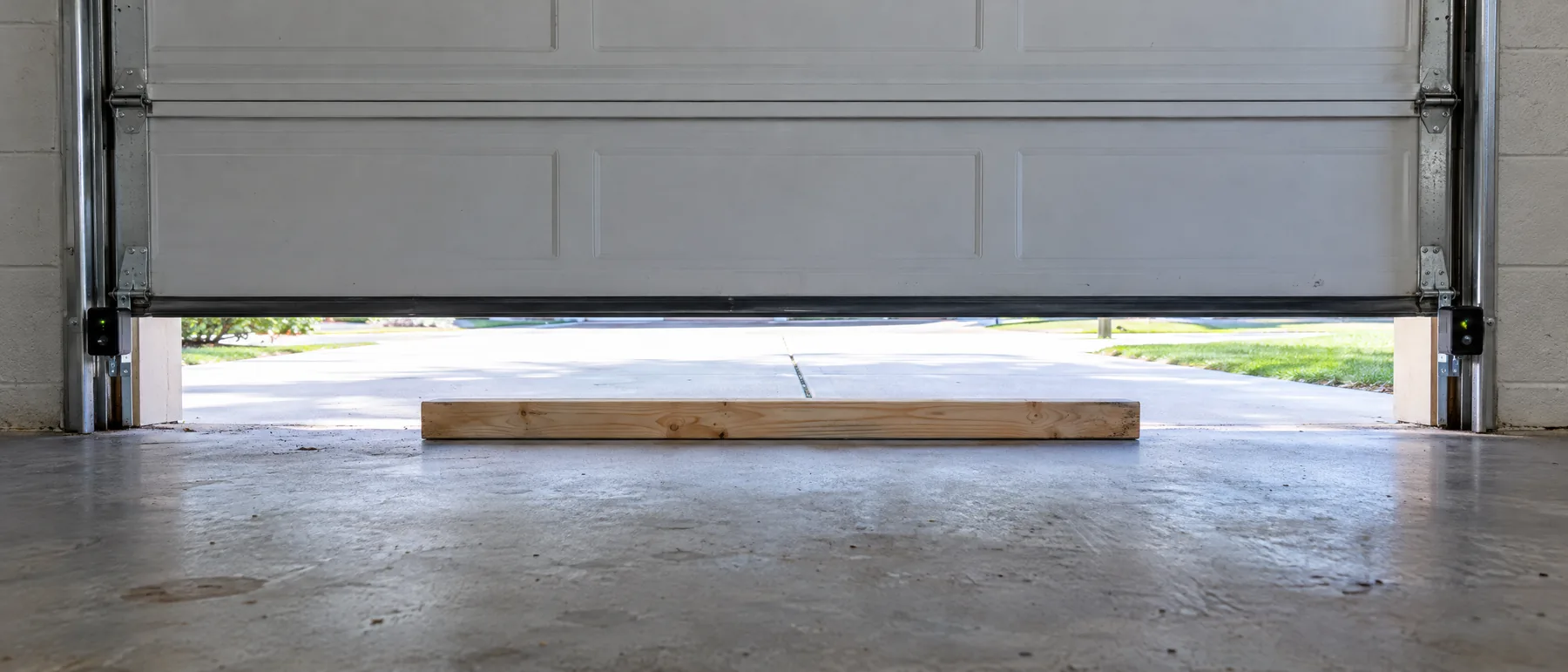
To test your garage door's auto-reverse, run two quick checks. First, break the safety sensor beam while the door is closing and make sure it stops and goes back up. Second, lay a 2x4 board flat on the floor under the door, close the door onto it and make sure it reverses when it touches the board.
Door and opener safety guidance generally recommends doing both checks about once a month. If the door fails either one, stop using the opener until it is repaired. A door that will not reverse can close with enough force to injure someone.
Before you test the auto-reverse
- Keep children and pets out of the garage while you test.
- Clear the doorway and the floor under the door.
- Look at the springs and cables from a distance. If a spring is broken or a cable is frayed or slack, do not run the door at all.
- Stand where you can reach the wall button, well clear of the door's path.
- Have a 2x4 board ready, or another solid object about 1.5 inches thick.
Test 1: the photo-eye test
This checks the safety sensors, the pair of small units mounted low on the door tracks.
- Open the door fully.
- Press the wall button to close it.
- While the door is coming down, lower a broom handle or a similar object into the beam between the sensors. Stay to the side and keep your body out of the door's path.
- The door should stop and reverse.
If the door keeps closing, the sensors are not doing their job. Check that both indicator lights are on and steady, and see how the safety sensors work for what the lights mean.
Test 2: the reversal test with a 2x4
This checks the opener's contact reversal, the feature that sends the door back up when it presses against something the sensors did not see.
- Open the door fully.
- Lay a 2x4 flat on the floor in the middle of the doorway, under the door. Laid flat, it stands about 1.5 inches tall, low enough to sit under the sensor beam.
- Press the wall button to close the door.
- When the door touches the board, it should stop and reverse within a couple of seconds.
- Once the door is back up, take the board away.
If the door presses down on the board and stays there, or stops without going back up, the reversal is not working correctly. Do not repeat the test with a hand, a foot or anything soft in place of the board. The point of the board is that it is solid and low, so it tests the opener without risking an injury.
Door won't reverse? Have it repaired
A door that fails either test should not run on the opener. Leave it off and call to arrange a repair.
North Miami Beach repairWhat a failed auto-reverse test means
A door that fails the reversal test is not safe to run on the opener. Leave the opener unplugged and out of use until the fault is found and fixed. Common causes include:
- The close force on the opener set too high, so it pushes through resistance.
- The down limit set too low, so the opener treats the board as the floor.
- A door that is out of balance or binding in its tracks.
- A worn or faulty opener.
Opener manuals explain how the force and limit settings are adjusted, and they differ by model. Never turn up the force just to make a sticky door close. That hides the real problem and makes the door more dangerous.
How often to test your garage door's safety reversal
Once a month is the usual advice. Test again after any repair or adjustment to the door or the opener, and after a sensor has been knocked out of place.
Look at how the opener is set up, too. If there are no sensors near the floor at all, the opener likely predates the safety rules that have applied to openers sold in the United States since the early 1990s, and it lacks the beam protection newer openers include.
If you are in North Miami Beach and the door fails either test, see garage door repair in North Miami Beach to arrange a repair.
Other quick checks to run at the same time
The reversal tests tell you about the opener. A minute more tells you about the door it is pulling:
- Watch a full cycle. The door should open and close smoothly, without jerks, scraping or one side lagging behind the other.
- Listen. Grinding, popping or a new squeal often points to rollers, hinges or a spring that needs attention.
- Look, do not touch. Check the springs for a gap in the coils and the cables for fraying, from a safe distance.
- Check the balance. When the springs no longer carry the weight, the opener strains and can throw off the reversal. Testing your garage door's balance shows how.
Writing the date on a card near the wall button is an easy way to remember when you last tested.