Garage Door Panel Replacement
A car bumper, a stray ball or storm debris can crease one section of a garage door and leave the rest untouched. Often that one section can be swapped on its own. Momentum offers garage door panel replacement for damaged sections of existing doors in Bal Harbour, North Miami and the surrounding areas.
(954) 636-6320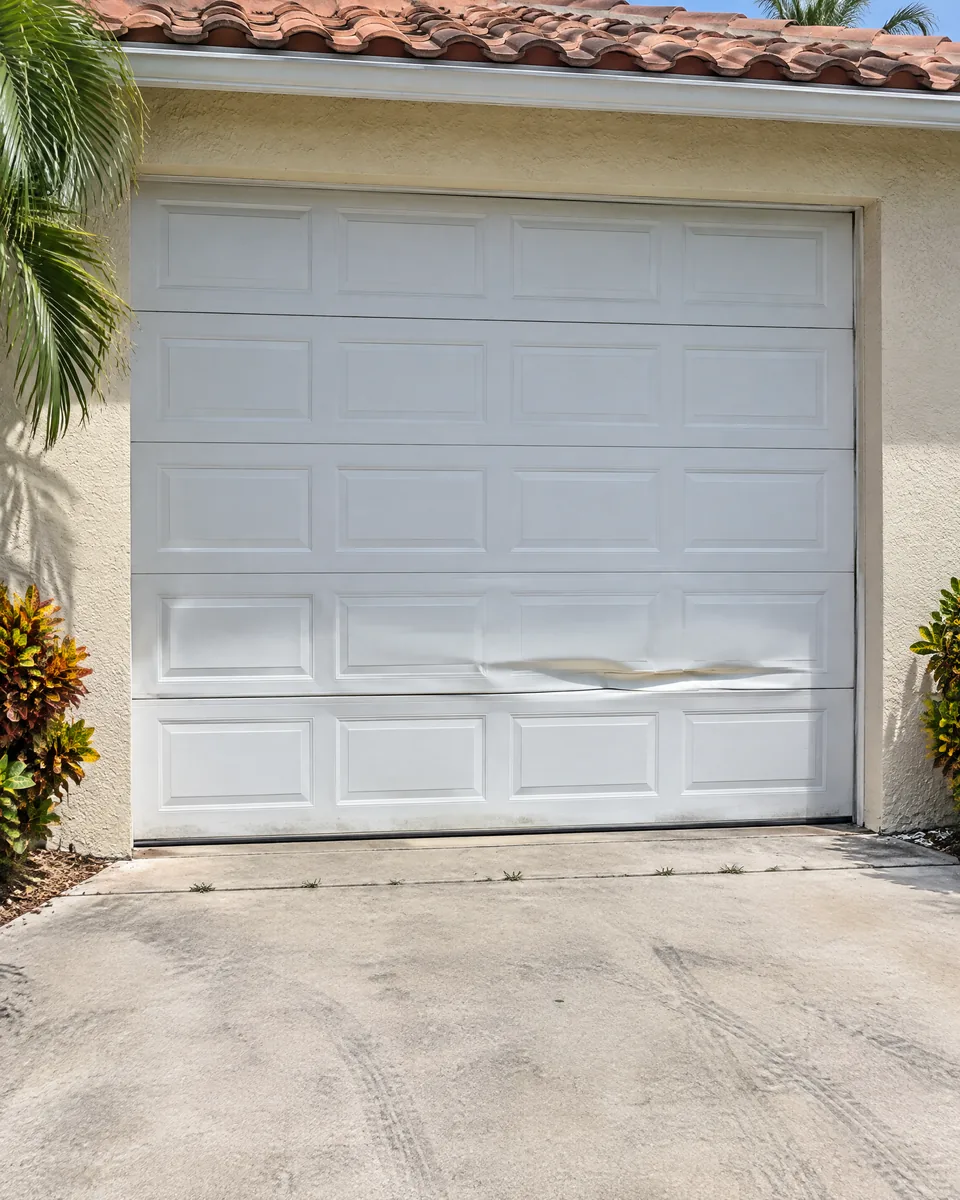
When a single section can be replaced
A sectional door is a stack of horizontal sections joined by hinges. Each section can usually come out on its own, but the new one has to match its neighbors closely for the door to look right and run straight.
A new section often works if
- The damage is limited to one or two sections.
- The door's make and model can be identified, often from a label on the inside of the door.
- A section with the same design, height, thickness and color is still available.
- The tracks, rollers and other sections are straight and sound.
- The dent is too deep, creased or torn to push back out.
A section swap may not be the answer if
- That door line has been discontinued and nothing matches.
- Several sections are bent, or the damage reaches the tracks.
- The dent is shallow and the steel isn't creased, so it may be worked out instead.
- The door has rusted through in several places, not just one section.
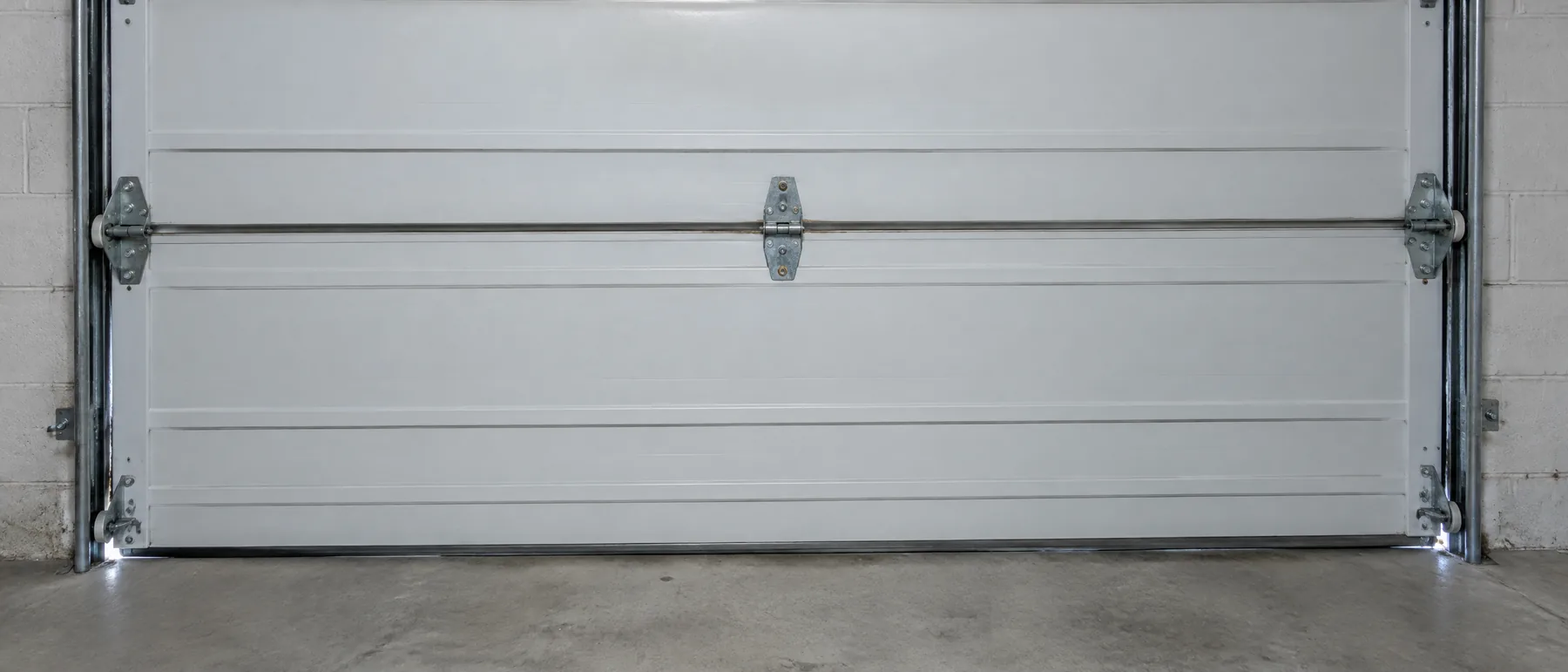
Five details a replacement section has to match
Two sections can look alike from the driveway and still be different parts. These are the details that decide whether a new one fits.
- Height and width. Sections come in set heights, and the new one has to line up with the hinges and the track of the door it joins.
- Face design. Raised, flush, ribbed and carriage-style faces each have their own pressed pattern, and it has to carry across the joint.
- Thickness and insulation. A single-layer steel section and an insulated one differ in depth, which changes how the hinges and seals sit.
- Color and finish. Paint on the old sections can fade, especially on a door that faces strong sun, so a new section may look a shade brighter at first.
- Its place in the stack. The top and bottom sections differ from the middle ones, with fittings for the top bracket or for the bottom seal and cable brackets.
The bottom section holds the cable brackets, and those are under spring tension. That makes a bottom-section swap a job for a trained technician, not a weekend project.
Damage that calls for garage door panel replacement
Creased dents
When steel folds along a sharp line, pushing it back out usually leaves a weak, visible crease. A new section is the cleaner fix.
Cracks near the hinges
Cracks around hinge screws or along the joint edges tend to grow as the door opens and closes, and a weak spot can let a hinge pull loose.
A bent section that throws the door
A section pushed inward can twist the rollers out of line and pull the door out of its track.
Off-track repair →Rust at the bottom edge
Standing water and salty air can rust the lowest section from the bottom edge up. Once the steel is eaten through, paint won't hold it together.
Impact-rated doors
A door sold as impact-rated was tested as a complete assembly. A replacement section should be the matching part made for that door, so the make and model matter even more.
What a garage door section is made of
Before you can match a section, it helps to know what one is. DASMA, the trade association for door makers, defines a section as the part of the door that runs the full width of the opening and is joined to the next one by hinges. Most steel sections are built from the same few parts.
The skin
The face you see from the street is a thin sheet of steel pressed into a raised, flush or ribbed pattern. The steel is usually galvanized, which means coated in zinc to slow corrosion. A pre-finished door is primed and then given an oven-baked top coat.
Stiles
These are vertical strips that stiffen the section. End stiles at each edge hold the hinges that carry the rollers. Center stiles hold the center hinges.
Rails and joints
The top and bottom edges of a section are its rails. Where two sections meet, the edges are shaped to nest together, often as a shiplap or tongue-and-groove joint, to keep rain out. A new section's joint has to fit the profile of the sections above and below it.
Struts
A strut is a horizontal stiffener fastened across the back of a section. It keeps the door from sagging when it's open, and it raises the door's wind-load capacity. On a wind-rated door the struts are part of the tested design.
Insulation
An insulated section has a core between the outer skin and a second skin on the inside. Polyurethane foam is commonly foamed in place at the factory. DASMA points out that an R-value is calculated for one section, while a U-factor is measured on a whole installed door, so the two numbers can't be compared.
Steel gauge, in plain numbers
Steel thickness is described by gauge, and the scale runs backwards. A bigger number means thinner steel. DASMA publishes a chart of the minimum thickness for each gauge, both bare and galvanized. Codes such as G-60 and G-90 are galvanizing weights. A heavier zinc coat adds a little thickness and more protection from rust, which counts for a lot in salty air.
Gauge shows up all over a door, not just on the face. On one manufacturer's Miami-Dade approved drawings, for example, the hinges are 14-gauge galvanized steel and the bottom brackets are 11-gauge, about 0.114 inch thick. Sheet-steel section skins sit at the thin end of the same chart.
| Gauge | Bare steel | G-60 galvanized | G-90 galvanized |
|---|---|---|---|
| 11 | 0.1136 | 0.1146 | 0.1151 |
| 12 | 0.0986 | 0.0996 | 0.1001 |
| 14 | 0.0697 | 0.0707 | 0.0712 |
| 24 | 0.0209 | 0.0219 | 0.0224 |
| 25 | 0.0179 | 0.0189 | 0.0194 |
| 26 | 0.0159 | 0.0169 | 0.0174 |
| 28 | 0.0129 | 0.0139 | 0.0144 |
DASMA also says gauge is only one part of how a door performs, and that strength is best proven by testing the whole door. Two sections can look identical and still differ by a few thousandths of an inch of steel, which no one can see by eye. That's why a section is matched by its model number, not by how it looks.
Garage door panel replacement in the High-Velocity Hurricane Zone
Miami-Dade and Broward counties make up Florida's High-Velocity Hurricane Zone, the part of the state with the strictest Florida Building Code requirements. Miami-Dade County says the products that form a building's envelope, doors included, need an approval before they can be used there. That approval is a Notice of Acceptance, or NOA, issued by the county's Product Control Section.
An NOA covers one specific door: its model, its sizes and its design pressures, backed by drawings and test reports. The tests listed on one garage door NOA include static air pressure and cyclic wind pressure loading (Florida test protocols TAS 202 and TAS 203) and, for that impact-rated door, a large missile impact test (TAS 201).
Find the label first
That NOA requires a permanent label on the door's side track, bottom angle or the inner surface of a panel. It lists the maker, the model number, the positive and negative design pressures, whether the door is impact rated, and the NOA number. Photograph it before any part of the door is touched.
Identical parts keep the rating
DASMA warns that replacing parts on a wind-rated door with parts that are not identical may weaken the whole assembly. Where an outside agency certifies a door, a substitution outside that program's rules can void the certification. So a section for a rated door should be the maker's own section for that model and rating.
Struts and screws go back as they were
DASMA lists extra fasteners and set fastener locations among the small details that can decide whether a door holds in a storm. A section swap that leaves off a strut, or moves its screws, changes the door that was tested.
Section count follows door height
Approval drawings can even fix how many sections a door has. One aluminum model's drawing calls for four sections on a door 6'1" to 8'0" tall and five on a door 8'1" to 10'0" tall. A section of the wrong height won't line up with the rest of the stack.
If you don't know if your door is wind rated, the label usually settles it. Whether a section replacement needs a permit is a question for your city's building department.
What to note before you call about a damaged section
A few minutes with a tape measure and a phone camera makes the first call much shorter. Stay clear of the springs, the cables and the bottom brackets while you look.
- Take a photo of the whole door from the driveway, and a close photo of the damage.
- Find and photograph any label on the inside of the door or on a side track. Look for a make, a model number and, in Miami-Dade or Broward, an NOA number.
- Count the sections from top to bottom and note which one is damaged. Top, bottom and middle sections are different parts.
- Measure the width of the door and the height of one section, from joint to joint.
- Note the face pattern, any windows and the color. If a window is cracked, mention it separately.
- Look at the edge of a section from inside. An open, hollow back means a single-layer section. A second skin on the inside means it's insulated.
- Watch whether the door still sits straight. DASMA says any bending of panels, tracks or hardware can make it doubtful the door will operate safely, so if something looks bent, leave the door closed.
- If you live in a condo or HOA community, check the association's rules on door color and style. Who handles an HOA garage door repair explains what to look for.
Then call Momentum on (954) 636-6320. Calls are answered 24 hours a day, 7 days a week.
Why the top and bottom sections are different jobs
DASMA's bottom bracket warning label says the bracket is under extreme spring tension and can cause serious injury or death. It says only a trained door systems technician should adjust, repair or remove it. The lift cables end at those brackets, so the bottom section can't come out until the spring tension has been safely taken off.
The top section
The top section carries the top roller fixtures, and on most homes the opener arm bolts to it. DASMA's general safety label notes that the top section may need reinforcing when an electric opener is attached. A new top section needs the same reinforcement the old one had.
Weight and balance
Garage doors weigh from about 90 to over 500 pounds, according to DASMA, and the springs are set for the door's original weight. A section that is heavier or lighter than the one it replaces, such as an insulated section in an uninsulated door, can throw the door out of balance. After any section swap, the balance is worth checking. The balance test shows how, and spring repair is the next step if the springs no longer match.
Nothing hung on the door
DASMA also advises against attaching trim or hanging storage on any part of the door or track without the maker's instructions. Added weight can unbalance the springs, and it can twist the horizontal track until the door falls out of it.
Panel replacement questions
Can I replace just one panel on my garage door?
Often, yes, as long as a matching section can still be found for your door. The make, model, face design, size and color all have to line up. If one of them can't be matched, the new section will stand out or may not sit right on the hinges and track.
Will the new section match my faded door?
It may look a little brighter at first. Painting the whole door afterwards is one way to even out the color.
Can a dented panel be repaired instead?
Shallow, rounded dents can sometimes be worked out. Sharp creases, tears and dents that bend the edge of a section usually can't. Fixing a dent in a garage door explains the difference.
Is it safe to keep using a door with a damaged section?
If the door still runs straight and quietly, it is usually fine for a short time. If it binds, leans or a roller has popped out, stop using it, because the door can leave its track.