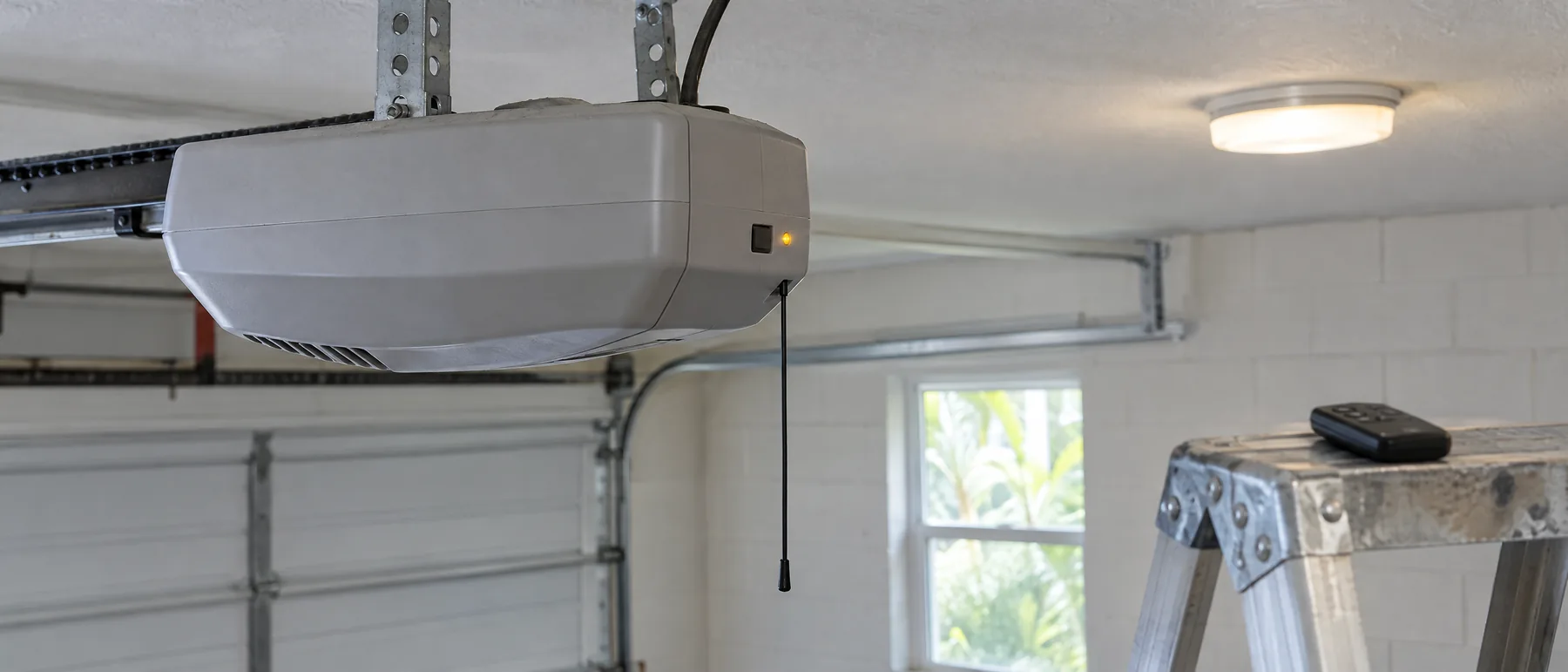
On most modern openers, you program a garage door remote by pressing the learn button on the opener's motor unit, then pressing the remote button you want to use within a short window. The opener stores the remote's code, its light blinks or it clicks, and the remote is ready to test.
The exact steps vary by brand and model, and so does how long the opener waits for you. Your opener's manual is the authority, and many manufacturers post their manuals online if yours is lost. What follows is the general method, how to clear remotes you don't want, and what to check when a remote won't pair.
Find the learn button
The learn button is on the motor unit hanging from the ceiling, not on the wall control. It is often a small square or round button near the antenna wire, on the back or side of the unit. On some models it sits behind the light cover, which has to be opened first.
Set up a sturdy stepladder where you can reach the button comfortably. Make sure the door's path is clear and nobody is standing under it, because the door may move while you test.
How to program a garage door remote with the learn button
- Press and release the learn button. Don't hold it. A small light beside it usually comes on to show the opener is listening. On many units that window lasts around 30 seconds.
- Press and hold the remote button you want to use for this door, within that window. Some models ask you to press it more than once.
- Let go when the opener responds. Its main light blinks or you hear a click or two, which means the code is saved.
- Test it. Climb down, stand clear of the door and press the remote button. The door should run.
Repeat for each remote. A keypad outside usually pairs the same way, with a PIN you choose entered on the keypad during the window. A car's built-in garage door buttons follow their own steps, which are in the vehicle's manual.
Get the opener checked
If no remote or wall button will run the door, the opener itself may need attention. Momentum covers garage door repair in Miramar, 24 hours a day.
Miramar repairsOlder openers with switches instead of a button
Some older openers have no learn button. They pair through a row of tiny switches, called DIP switches, inside the remote and inside the motor unit. The remote works when its switch pattern matches the opener's. Openers like these send one fixed code, which is easier to copy than the changing codes newer openers use. That's one reason homeowners with an old unit often move to a newer one, and Momentum offers opener installation for that.
Clearing old remotes after you move in
When you take over a home, you can't know how many remotes the previous owners, the builder or anyone else still has. Clearing the opener's memory removes every remote it has learned, so only the ones you pair afterwards will work.
On many openers you clear the memory by pressing and holding the learn button for several seconds, until its light goes out. On some models that erases keypads too, while on others they're cleared separately, so check the manual first. Then pair each remote you're keeping, one at a time, using the steps above. Have them all within reach before you start, so the house isn't left with no working remote.
Clearing the memory also drops any car that was paired before. Change the keypad PIN as well, and pair your own car again afterwards.
When the remote won't pair
- Check the battery. A weak battery is the most common reason a remote stops working or won't program.
- Check for a lock setting. Some wall controls have a lock or vacation feature that blocks remotes. While it's on, the opener ignores them.
- Make sure the remote is compatible. Openers use different radio systems, and a remote made for one won't always work with another. The remote's packaging or the opener's manual says what matches.
- Look at the opener's light. If it blinks in a pattern on its own, the opener may be reporting a fault. Why an opener light blinks covers the usual causes.
- Test from closer in. Try the remote from inside the garage first. If it only works up close, the battery or the antenna is the likely cause.
- Check the antenna wire. It should hang down freely from the motor unit, not be cut, tucked away or wrapped around metal.
When the problem is the opener, not the remote
If the wall control won't run the door either, the remote isn't the problem. The same goes for a door that starts to close and then reverses, which usually points to the safety sensors near the floor. See how garage door safety sensors work.
If you're in Miramar and the opener has stopped responding, Momentum can help with your Miramar garage door repair, including opener repair.