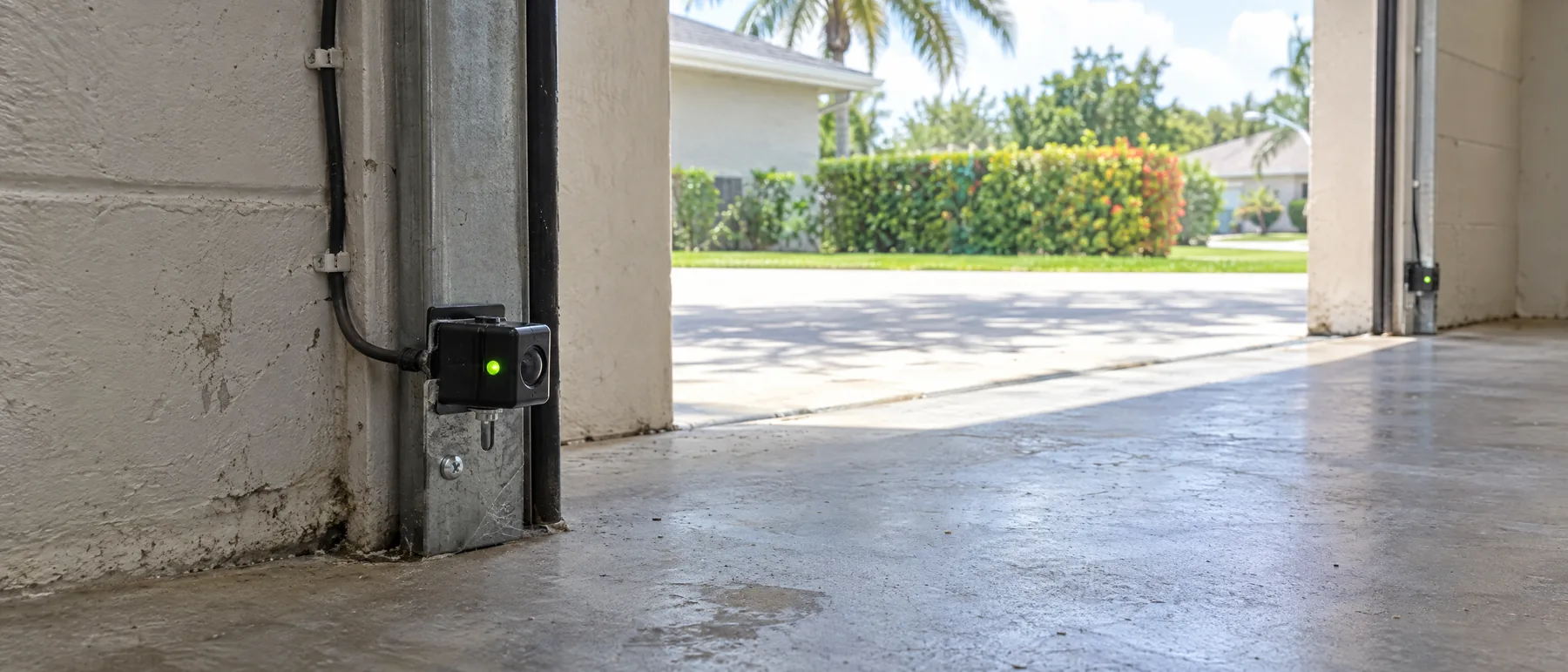
Garage door sensors work by sending an invisible beam of infrared light across the doorway, just above floor level. One sensor sends the beam and the other receives it. If anything breaks that beam while the door is closing, the opener stops the door and reverses it.
That is their whole job. The sensors do not open the door and they do not feel pressure. They simply watch the gap under a closing door so it does not come down on a person, a pet or a car. When they fail, the usual sign is a door that heads down, stops partway and rises again.
How garage door safety sensors work
The two units are mounted on brackets at the bottom of each door track, facing each other. The sending unit projects a narrow infrared beam. The receiving unit watches for it and reports to the opener through a thin low-voltage wire.
While the door is closing, the opener keeps checking for that signal. If the signal drops, even for a moment, the opener stops and reverses. While the door is open or opening, a broken beam normally makes no difference, which is why you can walk under an open door without anything happening.
The sensors sit low on purpose. Safety standards call for them to be mounted close to the floor, typically no more than about six inches up, so the beam catches a small child or a pet. Since the early 1990s, US rules have required this kind of entrapment protection on new residential openers.
What the indicator lights mean
Most sensors have a small light on each unit. Colors vary by brand, so check the opener manual, but the pattern is usually similar:
- A steady light on the sending unit means it has power.
- A steady light on the receiving unit means it can see the beam.
- A receiving light that is off, dim or flickering usually means the beam is blocked or the sensors are out of line.
- No light on either unit points to a wiring or power problem.
On many openers the main light also flashes when the sensors stop the door. If you see that, why the opener light blinks explains the common patterns.
Why garage door sensors stop working
- Misalignment. A sensor bracket gets bumped by a bin, a bike or a car bumper and ends up pointing slightly away from its partner.
- Dirty lenses. Dust, cobwebs or a film of salt and moisture can weaken the beam.
- Sun glare. Low morning or evening sun shining straight into the receiving unit can drown out the beam.
- Something in the way. A broom, a box or a hanging item can sit right in the beam's path.
- Wiring trouble. The thin sensor wires run along the wall and track, where a staple, corrosion or a loose connection can cut the signal.
- A failed unit. Sensors are electronic and can simply stop working, especially once moisture gets inside.
When sensors keep stopping the door
If the lights are steady, the lenses are clean and the door still will not close, the fault may be in the wiring or the sensors themselves.
Sensor repairHow to check if your sensors are working
- Clear anything away from the doorway and the bottom of the tracks.
- Look at both indicator lights. Both should be on and steady.
- Wipe each lens gently with a soft, dry cloth.
- Start the door closing with the wall button, then dip a broom handle into the beam partway down. Stand to one side, never under the door.
- The door should stop and go back up. If it keeps closing, stop using the opener until the sensors are fixed.
The sensors are only half of the safety system. The opener also has a separate reversal feature that reacts when the door touches something. Testing your garage door's auto-reverse walks through both checks.
Why sensors should never be bypassed
When sensors keep stopping the door, it is tempting to unplug them, move them up the wall or find a way around them. Don't. A door coming down with no working sensors can close on whatever is underneath it.
Many openers will still close the door if you press and hold the wall button, as a stopgap for faulty sensors. Only do this while you can see the whole opening, and get the sensors fixed rather than relying on it. If the door keeps reversing for no clear reason, see garage door sensor repair.
Keeping garage door sensors reliable
A lot of sensor trouble starts with the garage around them, not the sensors themselves. A few habits keep false stops to a minimum:
- Glance at the indicator lights now and then. A receiving light that has started to flicker is an early warning that the sensors are drifting out of line.
- Wipe the lenses every so often, and more often in a humid or salty garage where a film builds up quickly.
- Check that the sensor brackets are snug on the track. A loose bracket lets a sensor droop over time.
- Keep stored items, bins and hanging tools clear of the area between the sensors.
- Look along the sensor wires for staples pinching them, chewed spots or loose ends at the connections.
If you do move a sensor to clean it, aim it straight back at its partner until the receiving light glows steadily, then close the door once while you watch.