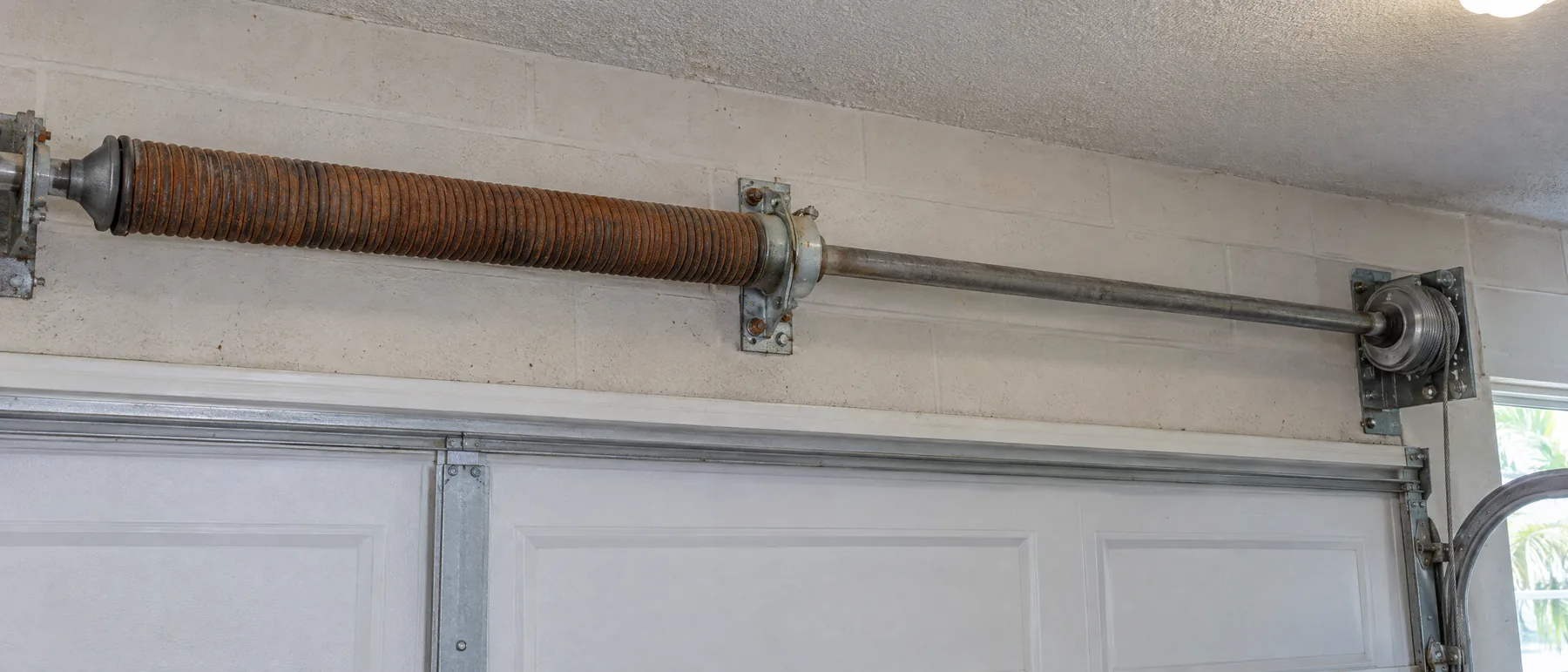
Garage door springs don't wear out by the calendar. They wear out by use. Most standard springs are rated for a set number of cycles, and one cycle is the door going up once and coming back down. Many manufacturers rate a standard spring at around 10,000 cycles, so how long garage door springs last depends mostly on how often your door moves.
A household that opens and closes the door four times a day runs up roughly 1,460 cycles a year. At that pace a 10,000-cycle spring lasts a little under seven years. Use the door twice as often and you can expect about half that. Salt air, humidity and a spring that is the wrong size for the door can shorten it further.
Below is a simple way to estimate where your springs are in that life, how the two spring systems compare, and the signs that a spring is close to the end.
How garage door spring lifespan is measured
A garage door spring is a coil of tempered steel wire that stores energy. As the door opens, the spring gives that energy back to help lift the weight. As it closes, the spring is loaded up again. Over thousands of cycles the steel fatigues, and eventually it cracks, usually at one point on the coil.
Spring makers express this as a cycle rating. A standard spring is often rated around 10,000 cycles. Higher-cycle springs, made from heavier wire or longer coils, are commonly rated at 20,000 cycles or more. Two identical doors can need new springs years apart if one is used far more than the other.
A quick way to estimate yours
- Count how many times the door opens on a normal day. Include trips to the bins, kids on bikes and the door used as the main way in and out.
- Multiply that number by 365 to get cycles per year.
- Divide the spring's rating by your yearly cycles. If you don't know the rating, 10,000 is a fair starting assumption for a standard spring.
Treat the answer as a rough guide, not a countdown. A spring can fail early, and some run well past their rating.
Torsion and extension springs
Most residential doors use one of two spring systems. Torsion springs sit on a steel shaft above the door and twist as it moves. Extension springs run along each horizontal track and stretch when the door closes.
In their standard form, both types are commonly rated around 10,000 cycles. Torsion springs tend to give a smoother, more even lift, and when one breaks it usually stays on its shaft. Extension springs should each have a safety cable running through the middle, so a broken spring can't whip across the garage. If yours don't have one, have that looked at.
Signs your garage door springs are wearing out
A worn spring usually gives some warning before it breaks. Look and listen for:
- The door feels heavier than it used to when you lift it by hand.
- It won't stay put when stopped halfway, and drifts down or creeps up.
- One side of the door rises ahead of the other.
- The opener strains, slows down or reverses on the way up.
- Rust, flaking or visible pitting on the coils.
- On extension springs, gaps between the coils when the door is fully open, or one spring stretched longer than its partner.
A torsion spring that has already broken is easy to spot. Look at the spring on the shaft above the door. A clear gap in the coil means it has snapped, and many people hear a loud bang from the garage when it happens.
The door balance test is a simple way to judge spring condition without touching the springs.
Have the spring replaced safely
A broken or badly worn spring is a job for someone with proper winding bars and training. Keep the door down and call about spring repair.
Spring repairWhat shortens a spring's life
Use is the main factor, but a few things can take years off a spring.
- Salt air and humidity. Near the coast, salt settles on the coils and holds moisture against the steel. Rust pits the surface of the wire, and those pits are where fatigue cracks tend to start. The care that slows this down is covered in keeping salt air off door hardware.
- A spring sized wrong for the door. Springs are matched to the door's weight. If the door has gained weight from added insulation or a heavier replacement section, or the spring was undersized to begin with, it is wound or stretched further than it was built for on every cycle.
- Dry coils. Coils that rub together with no lubricant wear faster. A light spray of garage door lubricant along the spring a couple of times a year helps.
- Heavy daily use. A garage that serves as the family's front door can use up a standard spring's rating in just a few years.
When a spring is near the end of its life
Springs are not a do-it-yourself part. A torsion spring holds enough wound-up force to lift a door that can weigh well over a hundred pounds, and releasing it with the wrong tool can cause serious injury. Leave the springs, the cables and the bottom brackets alone, and keep using the door only while it moves smoothly and stays balanced.
On a door with two springs, both have usually done the same number of cycles. That is why many technicians suggest replacing them as a pair, since the second spring is often not far behind the first. A replacement is also a chance to ask about a higher-cycle spring if the door sees heavy use.
If a spring has already snapped, leave the door closed and stop using the opener. A door with a broken spring can drop suddenly if someone lifts it or pulls the emergency release.
Making garage door springs last longer
Nothing makes a spring last forever, but a little routine care helps it reach its rating.
- Look at the springs every month or two for rust, gaps or a coil that looks stretched.
- Run the balance test a couple of times a year and note any change.
- Keep the garage as dry as you can. Good airflow or a dehumidifier helps in a humid climate.
- Book periodic garage door maintenance and ask for the springs to be checked while the door is looked over.