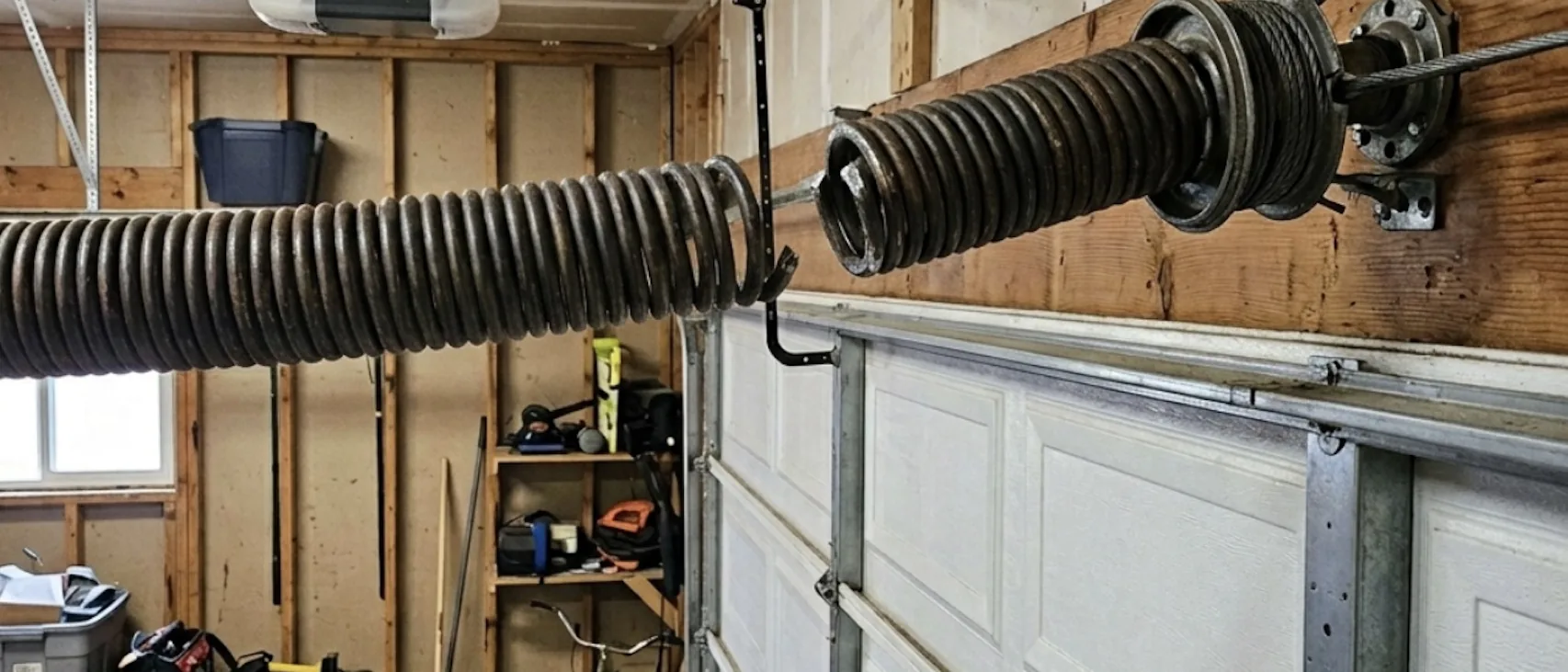
When a garage door track bracket is pulling away from the wall, the track is rarely the real problem. What has failed is the grip of the screws, or the wood they are driven into. The brackets hold each vertical track to the wooden jamb beside the opening, and the jamb is fastened to the wall. Once a screw loosens or the wood around it goes soft, the track shifts a little every time the door moves.
In a city with as much older housing as Hollywood, that is worth checking properly. A few minutes with a flashlight will tell you whether you are looking at a loose fastener, a track that needs re-securing, or framing that needs another trade. If the door has already jumped its tracks, stop using it and see Momentum's garage door repair in Hollywood page, where calls are taken at any hour.
Hollywood's mid-century housing and the wood behind the track
Census figures show how much of Hollywood was built in the decades after the Second World War. The American Community Survey for 2020 to 2024 counts 72,843 housing units in the city, with a median year built of 1969.
| Year built | Housing units |
|---|---|
| 1950 to 1959 | 16,788 |
| 1960 to 1969 | 17,946 |
| 1970 to 1979 | 16,201 |
| All years | 72,843 |
That puts close to half of the city's homes in the 1950s and 1960s alone. The same survey counts 31,651 single-family detached houses. Not every home has a garage, and many doors and jambs have been changed over the years. Still, in older garages the wooden jamb at the opening may have been in place for decades.
Wood near the floor takes the most punishment. Rain blown under the door, water off car tires and a hose run along the slab all end up at the base of the jamb. Over time the grain softens from the bottom up, and a lag screw that once bit hard starts to turn in a widening hole.
A three-point check of a loose track bracket
Close the door, unplug the opener so nobody runs it by habit, and work through these in order.
- The bracket. Hold the vertical track and rock it gently toward and away from the door. Note which bracket moves. Look at the gap between the edge of the door and the track as well. It should look about the same on both sides.
- The fastener. Look at the lag screw heads. One that stands proud of its washer has backed out. If you put a wrench on it and it turns freely without drawing tight, the hole is stripped.
- The wood. Press the tip of a screwdriver into the jamb beside each screw and near the floor. Sound wood resists. Wood that dents easily, crumbles, splits along the grain or looks dark and damp has lost its strength. Check, too, for a gap opening between the jamb and the wall behind it.
Only the brackets along the vertical track are part of this check. Leave the bottom bracket at the lower corner of the door alone, because the lift cable attaches there under spring tension. Leave anything on the spring assembly above the opening alone too.
Reading the results: a fastener problem or a framing problem
A screw that backed out of sound wood
This is the mildest case. Doors vibrate, and a screw can work loose over years. If the wood around it is firm and the screw draws tight again with the door closed, the track may simply need its alignment checked afterwards.
A screw that spins
The threads have nothing left to grip. Turning it harder only enlarges the hole. The bracket has to be fastened into fresh, solid wood, and the track lined up again as it goes back.
Wood that gives under the screwdriver
New screws in soft wood will pull out again, often within weeks. The damaged part of the jamb has to be repaired or replaced before the track can be properly fixed to it. That is carpentry, not garage door work.
A jamb moving away from the wall
If the whole jamb shifts, its own anchors into the block or concrete have loosened, or the wall around them has cracked. That is a framing or structural question, and it should be looked at before anything is hung back on it.
Get the track looked at
A track that leans away from the door can drop a roller at any time. Read the signs of bent and loose track, and what to do before the door comes off.
Off-track door repairWhy a garage door keeps coming off its track
Each roller sits on a stem that reaches only so far into the track. When a bracket lets the track lean away from the door, the gap on that side grows and the roller has less of the channel to ride in. Every trip, the door shoves the loose track a little further. Sooner or later a roller climbs the lip and the door twists in the opening.
That is why a door rehung on a loose track tends to come off again. The track has to be fastened back into solid material and set parallel and plumb before the door is used again. Other common causes, such as a slack cable or worn rollers, are covered on the off-track door repair page. If the names of the brackets are unfamiliar, the guide to garage door parts shows where the jamb brackets and flag brackets sit.
An unbalanced door can add to the problem, since it pulls unevenly on one side. The garage door balance test takes a few minutes and tells you whether the springs are still doing their share.
How a loose garage door bracket is properly reinforced
There is no single bracket kit that fixes every case. A lasting repair depends on what is behind the bracket. In general:
- Sound wood, stripped hole. The fastener goes into fresh wood, either by moving it to a new spot on the bracket or by using a fastener long enough to reach solid material, while the track stays where it belongs.
- Soft or split jamb. The bad wood comes out and new framing goes in first. Only then is the track fastened back.
- Loose jamb anchors. The jamb is re-anchored to the wall before any track work, so the track is not bolted to something that still moves.
Fixes that tend to fail include packing the hole with filler or glue, stacking shims behind a bracket to take up a wobble, and driving extra screws into the same soft board. They can make a bracket feel firm for a while without giving it anything solid to hold.
Why the jamb connection matters in a hurricane
The door and the frame around it work as one system when the wind blows. In its technical data sheet on connecting garage door jambs to building framing, the Door and Access Systems Manufacturers Association states that connecting garage doors to building framing is as important as the design of the doors themselves. The sheet sets out how far apart jamb fasteners may be spaced for a given door width and design wind load, and its schedule notes say supporting structural elements are to be designed by a registered professional engineer for wind loads.
For a homeowner, the point is simple. A strong door is only as secure as the wood and wall it is fastened to. If the jamb or the wall around the opening needs rebuilding, ask the contractor whether engineering or a permit applies before the work starts, and check with the city's building department if you are unsure. Getting the door itself ready for a storm is a separate job, covered in the hurricane checklist for garage doors.
Who fixes which part
| What you found | Usually a job for |
|---|---|
| A screw backed out of firm wood | A careful homeowner, or a garage door technician if the track has moved |
| A stripped hole, or a track out of line | A garage door technician |
| A soft, rotted or split jamb | A carpenter or framing contractor, before the track goes back |
| A jamb pulling off the wall, or cracked block around it | A licensed contractor, with an engineer where the structure is involved |
When in doubt, describe what the screwdriver test showed when you call. Saying that the wood is soft, or that the screw only spins, tells whoever answers which kind of help the door needs first.