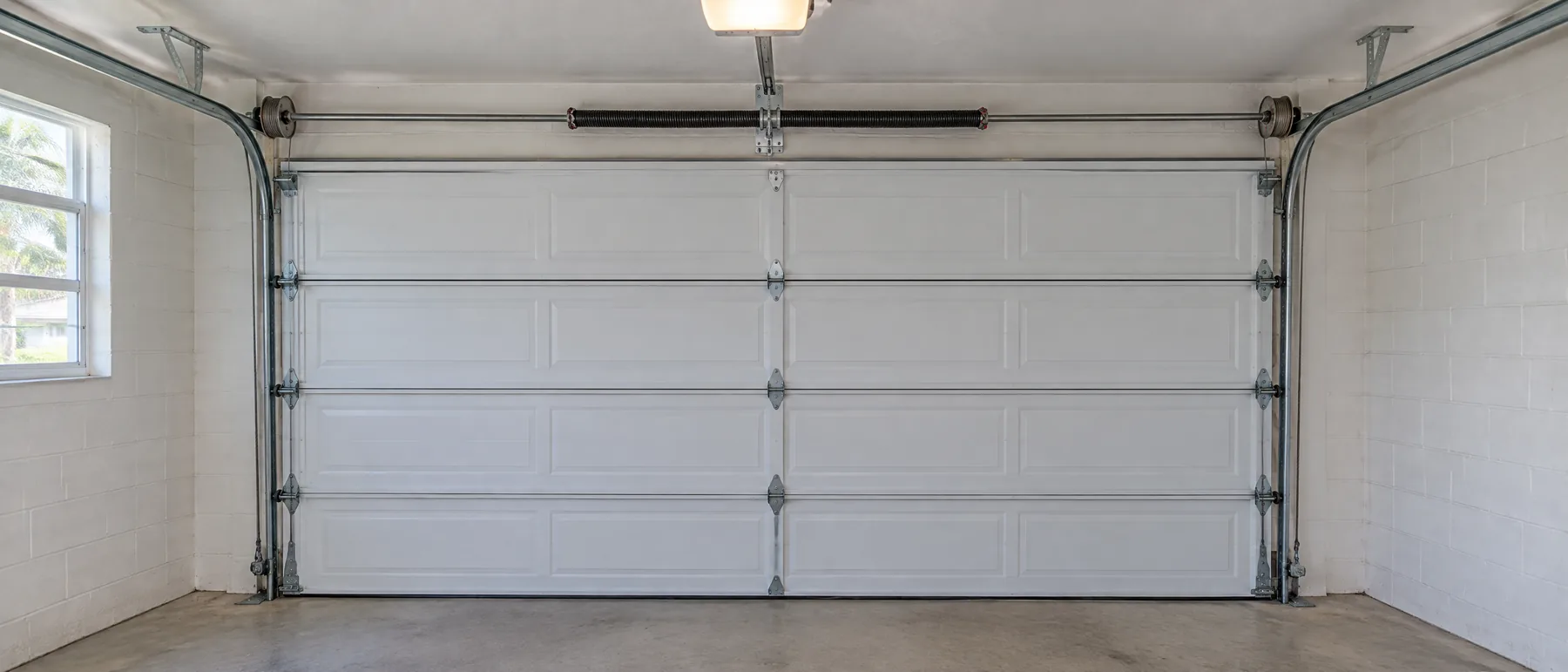
Most garage door parts names make sense once you see where each piece sits. A sectional door is a row of hinged panels that rides up two tracks. Springs and cables carry its weight, and an electric opener usually moves it. Learn those three groups and the rest of the parts fall into place.
This guide names each part, starting with the track system, because the tracks and rollers are what the door actually rides on. It also points out which parts are under heavy tension and should be left alone.
The track system: what the door rides on
The tracks are the steel channels on each side of the opening. A vertical track runs up the side of the door frame. A curved section, often called the radius, turns the door toward the ceiling, and the horizontal track carries it back into the garage.
- Track brackets, sometimes called jamb brackets, fasten the vertical tracks to the wall beside the opening.
- Flag brackets sit at the top of each vertical track and tie it to the horizontal track.
- Rear hangers are the straps or angle iron that hold the back ends of the horizontal tracks up to the ceiling.
The tracks only work if they stay parallel, plumb and firmly fastened. A bent track, a loose bracket or a hanger that has shifted can let a roller ride up and out of the channel. If that has already happened, the door needs off-track door and track repair, not a hard shove back into place.
Rollers, hinges and the brackets that hold them
Rollers are small wheels on a steel stem. The stem slides into a hinge or bracket on the edge of a section, and the wheel turns inside the track. You will see steel rollers, nylon rollers with ball bearings and basic plastic rollers with no bearings at all. How long each type tends to last is covered in our article on roller lifespan.
Hinges join one section to the next and let the door bend as it rounds the curve. On many doors the hinges are numbered. A higher number holds the roller a little farther out, so each section sits snugly against the frame when the door is shut.
Two brackets do more than hold a roller:
- The top bracket, or top fixture, holds the highest roller and can be set so the top section closes tight.
- The bottom bracket holds the lowest roller, and it is where the lift cable attaches. It is under constant spring tension and should never be loosened by hand.
A roller off the track needs a repair
If a roller has left the track or a track is bent, stop running the door. Forcing it can pull the sections out of line.
Off-track door repairSprings, cables and drums: the counterbalance
A garage door is heavy, and the opener is not what lifts that weight. The springs do. They store energy as the door closes and give it back as it opens, so a well balanced door feels fairly light when you lift it by hand.
Most sectional doors use one of two systems:
- Torsion springs are wound around a metal tube mounted over the door. As they unwind they turn that tube and the cable drums at each end. The drums wind up the lift cables, which raises the door. Bearing plates at the ends and in the middle hold the tube steady.
- Extension springs run along each side above the horizontal tracks. They stretch as the door closes and pull through pulleys and cables to help lift it. Each one should have a safety cable running through its center, there to hold the spring if it breaks.
Every part in this group holds enough force to cause serious injury. Look, listen and describe what you see, but leave adjustment and replacement to a trained technician.
Sections, struts and weather seals
The door itself is made of sections, also called panels, stacked one above the other. Each section has vertical stiles and end caps that give the hinges and roller brackets something solid to fasten to.
Wide or lightweight doors often carry struts. These are long steel reinforcing bars fastened across a section to stop it bowing. The top strut often gives the opener arm a firm place to pull from.
Around the edges are the seals:
- The bottom seal is a rubber or vinyl strip held in a retainer on the lowest section. It closes the gap at the floor.
- Perimeter weatherstrip, also called stop molding, runs up the sides and across the top of the frame and presses against the door when it is shut.
Garage door opener parts
A ceiling-mounted opener has a motor unit, often called the powerhead, and a rail that runs toward the door. A trolley rides along the rail, driven by a chain, a belt or a screw. The door arm links the trolley to a door bracket on the top section.
- The emergency release, usually a cord with a red handle, disconnects the trolley so the door can be moved by hand.
- The wall control, the remotes and any outside keypad send the open and close commands.
- The safety sensors are a pair of small photo eyes near the floor, one on each side. They stop a closing door if something crosses the beam between them. How garage door sensors work explains their lights and common faults.
Which garage door parts are safe to handle
Some parts are fine for a homeowner to clean or check. Others are not.
- Usually fine: wiping the tracks clean, checking that hinge and track bolts are snug, changing a remote battery, cleaning the sensor lenses and looking over the bottom seal.
- Leave alone: springs, cables, drums, bottom brackets and anything attached to them. They hold the door's weight under tension all the time, even when the door is closed.
If you are not sure which part you are looking at, describe where it sits and what it is doing when you call. The right name for a part makes the problem quicker to explain.