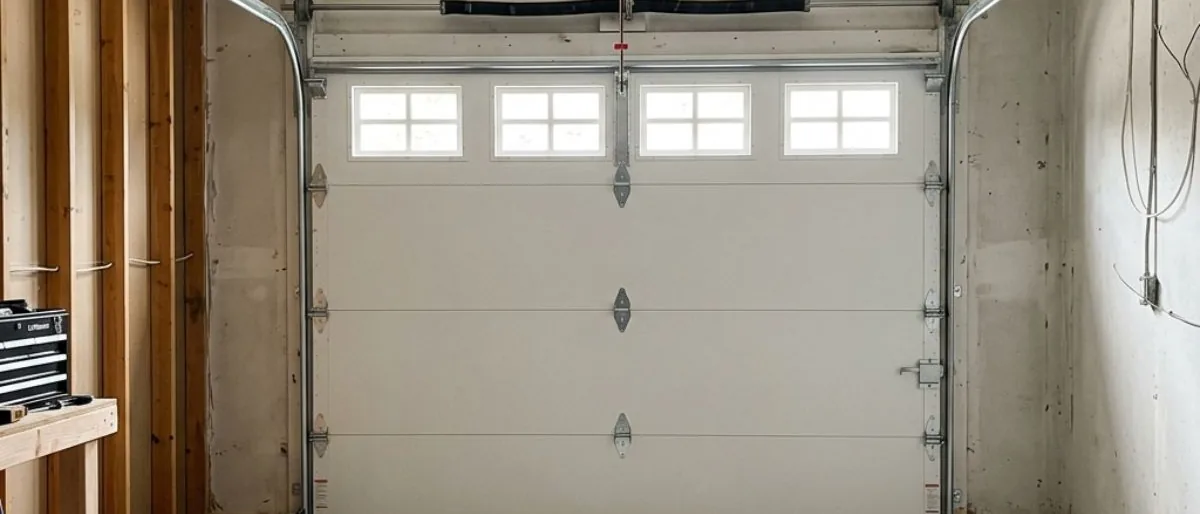
The wind load label on a garage door is almost always on the inside of the door, and it is usually small. Manufacturers place it in different spots, so start with a flashlight along the side edges of each section and around the bottom section. The label names the maker, the model or series and the pressure the door was rated to hold. Those details decide which replacement parts can be used on it.
That makes the label the first thing to find before ordering a single new panel. A section that looks the same from the driveway may not be the same part. This guide covers where to look, what each line means and what to do if the label is gone. If the door needs help today, see Momentum's garage door repair in Miramar page, with calls answered 24/7.
Where is the wind load label on a garage door?
Work with the door closed and the opener unplugged, so nobody runs it while you are close to it. Then check these places in order:
- The side edges of each section, on the inside face, from the top section down. Labels are often placed along these edges.
- The bottom section, close to the floor and the bottom corners. Stay clear of the bottom brackets, where the lift cables attach under tension.
- The top section, near where the opener arm connects.
- Your paperwork. Installation papers or a closing file from when the house was bought may name the door's maker and model.
Older labels fade. A phone photo taken with the flash at a low angle often brings up print that is hard to read by eye. Wipe a dusty label gently with a dry cloth rather than a cleaner, which can lift the ink.
Don't mistake other tags for it. Many doors also carry a warning label near the springs or the bottom brackets, and the opener has labels of its own. The wind load label is the one that lists pressures.
What each line on a wind load label means
Label layouts vary, but the information on them tends to fall into the same few fields. DASMA's sheet on the International Residential Code and wind load labels quotes the code's requirement for a permanent manufacturer's label that identifies the manufacturer, the model or series number and the design wind pressure rating. A 2006 Florida workgroup report, covered below, also listed an installation drawing reference and a product approval number.
| On the label | What it tells you |
|---|---|
| Manufacturer | Who made the door, and who to ask about matching parts |
| Model or series number | The exact door line. Sections and hardware are matched to this, not to the look of the door |
| Design pressure, positive | The pressure in pounds per square foot the door was rated to resist when wind pushes it into the garage |
| Design pressure, negative | The same rating for wind pulling the door outward |
| FL or NOA number | A Florida product approval or Miami-Dade Notice of Acceptance number, if the product has one |
| Installation drawing reference | Which drawing set shows how the door and its fasteners were to be installed |
Write every line down, or keep the photo. It is the most useful thing you can have ready when you ask about a repair.
Why the wind code on a garage door is psf, not miles per hour
People often expect a wind label to show a wind speed. It doesn't. DASMA explains that the building code requires design pressure in pounds per square foot on the label, and that a manufacturer cannot simply rate a door to a wind speed. The pressure a door has to meet depends on more than speed: the exposure of the site, the height of the roof, the size of the door and where the house sits.
There is no single standard wind load for a garage door. Across the country, DASMA says, the resulting design pressures run anywhere between about 10 psf and more than 70 psf, and the minimum is set job by job. The local building department, which DASMA calls the authority having jurisdiction, is the final word on what a particular door must meet. If you need to know what applies to your Miramar home, ask the city rather than guessing from a chart.
This is also why two doors that look alike can carry very different numbers. The label belongs to the door that was built for a particular rating, and the face pattern says nothing about it.
Ask about a matching section
With the maker, model and design pressure written down, it is far easier to find out whether a matching section exists for your door.
Garage door panel replacementMiramar's newer housing and the label on its doors
Miramar is younger than most of the cities around it. The American Community Survey for 2020 to 2024 counts 46,380 housing units, with a median year built of 1996. Of those, 15,091 were built between 2000 and 2009, 3,564 between 2010 and 2019, and 651 in 2020 or later. Single-family detached houses make up 28,899 of the total.
Those figures can't tell you what is on any one garage. A newer house is no guarantee of a rated door, and doors get replaced. What they do show is that many Miramar garages went up in the same years Florida was working out what a garage door label should say.
In November 2006 a Florida Building Commission workgroup on garage door and shutter labeling recommended that garage doors carry a permanent label showing the positive and negative design pressure, the installation drawings reference number, and the FL or NOA number when the product has one. That report was a set of recommendations to the Commission, not code text, so treat it as background on what a label is meant to show.
When there is no label, or you can't read it
A missing label has a few common explanations:
- It faded or peeled. Heat, sun through the windows and humidity all wear labels down.
- It was painted over when the inside of the door was refreshed.
- The door isn't wind rated. DASMA notes that not every garage door is wind load rated, and that a door without a rating does not get a wind load label.
Without a label, the next best clues are the maker's name stamped or printed elsewhere on the door, the hardware pattern, and any paperwork from the installation. Clear photos of the whole inside face, the struts, the hinges and the section edges give the manufacturer something to work with if you ask them to identify the door. Don't guess a model from a similar door down the street.
Matching a replacement panel to a rated door
DASMA's sheet on component substitution warns that a part that looks similar may not offer the same strength as the original, and that differences in material thickness can be too small to see. For a section, that means the match comes from the label, not from the color or the pattern on the face.
- Give the supplier the maker, the model or series, and the design pressure.
- Ask for the section made for that model at that rating, with the same struts and hinge pattern.
- Ask which position it is for. Top, middle and bottom sections are often built differently.
Sometimes the honest answer is that no matching rated section is made any more. In that case the door may not be repairable by swapping one panel, and a look-alike section is not a fix. A shallow dent that hasn't creased the steel may not need a new section at all, and the guide to fixing a dent in a garage door explains when that applies. The panel replacement page covers the other details a new section has to match.