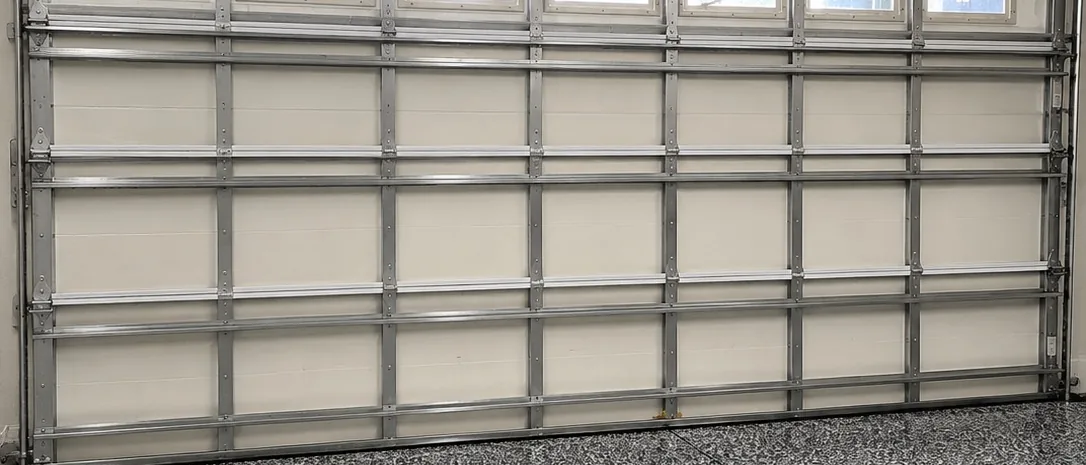
Yes, you can replace parts on a hurricane-rated garage door, but the new part has to be the same as the one it replaces, not just one that fits. A wind-rated door was tested as a complete assembly. Its rollers, track, hinges, fasteners and struts are all part of that rating, and a part that looks right can still be weaker in ways you cannot see.
That question comes up often in Pembroke Pines, where a large share of homes went up in the 1990s. This guide walks through each part that wears out and what matching it really means. If your door has stopped working altogether, start with Momentum's garage door repair in Pembroke Pines page, where calls are answered day and night.
Pembroke Pines homes from the decade after Andrew
The American Community Survey for 2020 to 2024 counts 67,235 housing units in Pembroke Pines. Of those, 24,268 were built between 1990 and 1999, about 36 percent, and the median home was built in 1992.
| Year built | Housing units |
|---|---|
| 1980 to 1989 | 13,987 |
| 1990 to 1999 | 24,268 |
| 2000 to 2009 | 8,486 |
| All years | 67,235 |
Hurricane Andrew struck South Florida in August 1992. A 2003 article in DASMA's trade magazine notes that garage door makers had been wind-testing doors for decades, but that specialized testing accelerated after Hurricane Andrew and the changes to the South Florida Building Code that followed.
None of that tells you what is on your garage. Many homes of this era may have wind-rated doors, but a door can be swapped several times over thirty years. Check the door itself, not the year on the house.
What makes a garage door hurricane rated?
A rated door has been tested to hold a stated design pressure, measured in pounds per square foot. DASMA's sheet on garage doors and high wind events points out that wind can push a door into the garage or pull it out of the opening, so both a positive and a negative pressure rating matter.
The rating belongs to the whole door, built the way it was tested. DASMA names the test standards ANSI/DASMA 102 and 108. A door is not rated because one strong part was added to it, and it does not stay rated if a part is swapped for a weaker one. On many rated doors you can spot the difference from inside: steel struts running across the sections, heavier hinges, more fasteners than a standard door has, and sometimes thicker track.
Wind load and impact are related but separate questions. DASMA lists whether a door has to resist wind-borne debris as its own factor, apart from the pressure rating. A door rated for pressure is not automatically rated for impact, so don't assume one from the other when you order parts.
Can you replace parts on a hurricane rated garage door? Part by part
DASMA's technical data sheet on component substitution says that replacing parts on tested, certified or wind-load-rated doors with parts that are not identical may weaken the whole assembly, and may expose whoever made the substitution to liability. It lists extra fasteners, unique fastener locations, extended roller lengths, higher-strength roller bearings and greater track thickness as subtle features that can be critical. Here is what that means for each part.
Rollers
A rated door may use rollers with a longer stem or a stronger bearing than a standard door. A shorter roller can still slide into the hinge and turn in the track, yet sit less deeply in the channel when wind pushes on the door. Replacement rollers should match the original stem length and bearing type. The roller replacement page covers the wear signs.
Track
Track is made in different steel thicknesses, and the difference can be too small to see. A bent section of track on a rated door should be replaced with track of the same gauge and profile, fastened at the same points.
Hinges and fasteners
Count the screws before anything comes off. A rated door may have more of them, in places a standard door doesn't use, and each one goes back in the same hole with the same type of fastener.
Struts
The horizontal struts are part of what was tested. A strut that is bent or rusted through should be replaced with the one specified for that door, in the same position.
Sections
A replacement section has to be the rated section made for that model, not a look-alike from another line.
Have the springs checked
Struts and heavier hardware add weight, and springs have to match it. A door that feels heavy, drifts down or bangs shut usually has a spring problem.
Garage door spring repairWhy you should not add bracing or struts yourself
Adding steel to a door sounds like a cheap way to make it stronger. DASMA's sheet on garage doors and high wind events advises owners not to add reinforcement themselves. Extra weight can be more than the tracks and other parts were built to carry, and a proper upgrade can require a package with suitable springs, hardware and track. The same sheet warns against parking a vehicle against the door as a brace, which can damage both.
Weight is where springs come in. The springs are sized to the door's real weight, struts included. Add weight and the old springs no longer balance the door, so the opener strains and the door may drop faster than it should. Take a strut off and the door may fly up. Any change in weight means the springs need to be checked, and that is work for someone trained in garage door spring repair. Getting the door ready before a storm is a separate job, covered in the hurricane preparation checklist.
Can you replace just one section of a wind-rated door?
Often you can, as long as the manufacturer still makes the matching rated section for that model. The new section has to carry the same struts, hinges and fastener pattern as the one it replaces, and it has to line up with the sections on either side. The panel replacement page explains the matching details that apply to any door.
If the line has been discontinued, a matching rated section may simply not exist. That is worth finding out before anything is taken apart, so ask the manufacturer, or a supplier working from the label, before the damaged section comes off the door.
Some doors carry a certification run by an independent agency. DASMA notes that component substitutions on those doors usually have to follow the program's written guidelines, and that the agency may invalidate the certification if a part is substituted contrary to them. When there is any doubt, DASMA's advice is to contact the original manufacturer.
Questions to ask before a part goes on your door
- What door is this? Find the maker and model, usually on a label on the inside of the door, and photograph it before any work starts.
- Where is the part from? A part from the door's manufacturer, or one its guidelines name as an equivalent, is the safe choice.
- Is it the same size and weight? Stem length, bearing type, track gauge and strut profile should all match.
- Do the fasteners match? The same number, in the same holes, of the same type.
- Does the weight change? If it does, the spring balance has to be checked before the door goes back into daily use.
- Is it written down? Keep part numbers and receipts with the photo of the label, so the next repair starts from what is really on the door.
A rated door that is repaired with matching parts can keep doing its job for years. One that slowly collects odd parts may look fine until the day it is tested by the wind.